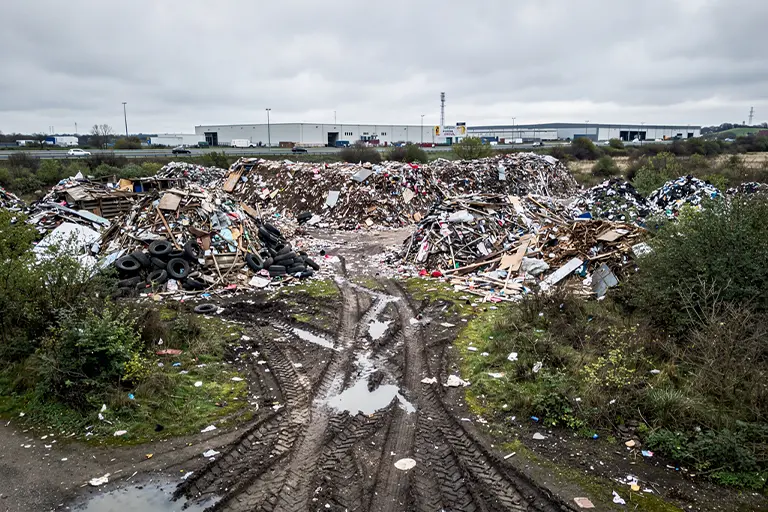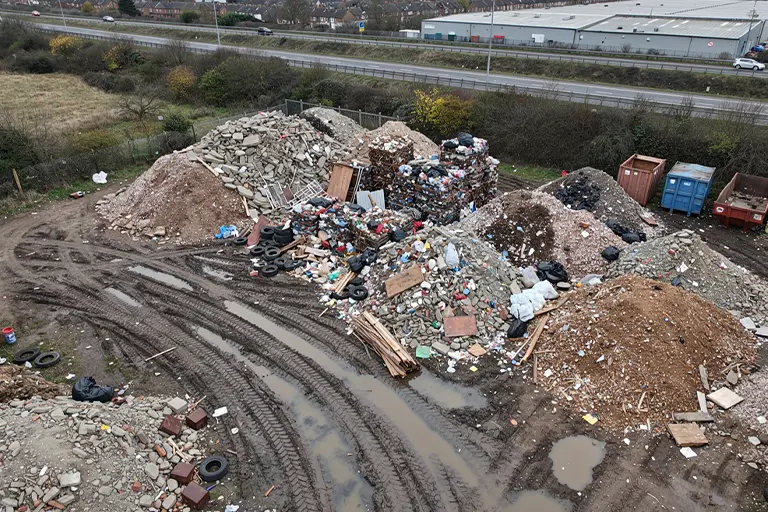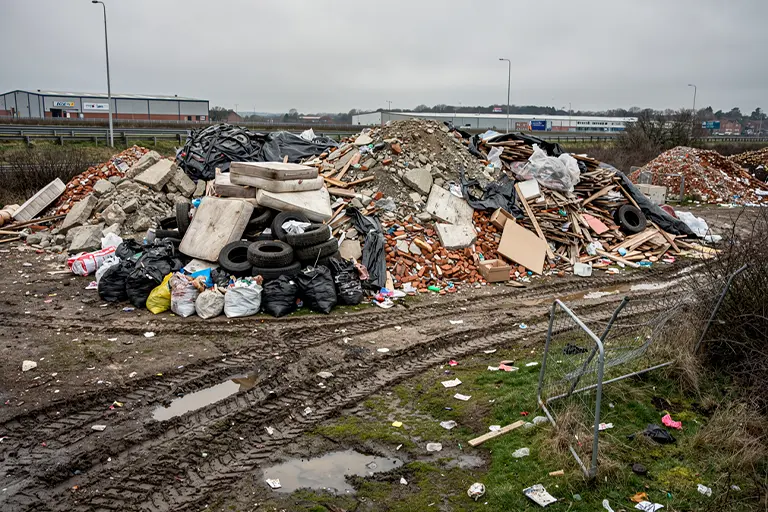
Illegal waste dumping in the UK has quietly grown into one of the country’s most damaging environmental crimes. It’s no longer just a few bin bags left at the side of a lane. Across the country, illegal dumps, unregulated illegal waste sites and industrial-scale tipping operations are putting pressure on councils, poisoning landscapes, and undermining communities.
Government-commissioned research has estimated that waste crime costs the English economy around £1 billion per year, with tens of millions of tonnes of waste being mismanaged or dumped illegally instead of handled through legitimate routes. At the frontline, local authorities recorded more than a million fly-tipping incidents in a single year, and those figures don’t capture the full scale of large, long-running illegal dumps that sit on the edge of towns and villages.
When people hear the term illegal dumps, they often picture fly-tipping, a van load of household rubbish pushed into a layby or farm track. But in many parts of the UK, the problem has escalated into something much more serious:
- Illegal waste sites operating as unlicensed tips or transfer stations
- Huge illegal dumps UK-wide in disused quarries, woodlands and industrial plots
- So-called “super sites” where waste piles reach tens of thousands of tonnes
These are not just unsightly. They create:
- Long-term health and environmental risks
- Constant stress for nearby residents and businesses
- Massive clean-up bills for landowners and councils
At the same time, organised criminal groups are exploiting gaps in regulation, enforcement capacity and waste infrastructure. Illegal waste dumping has become a highly profitable business model, one where offenders are paid to “take waste away” and then simply abandon it on land that isn’t theirs.
Against this backdrop, councils are under huge pressure. They must:
- Respond to complaints and community concern
- Work with regulators and landowners to establish responsibility
- Plan safe, lawful clearance of dangerous sites
- Do all of this within tight budgets and competing priorities
Our role in this article is not to criticise local authorities. Instead, we want to:
- Explain how illegal dumps and illegal waste sites develop
- Explore the real impact of illegal waste dumping on communities
- Show where proactive security can help stabilise high-risk sites and support a visible, coordinated response
In the sections that follow, we’ll look at how these sites form, why they’re so hard to deal with, and how councils and landowners can bring together enforcement, environmental expertise and on-the-ground security to protect people and places.
What Is an Illegal Waste Site, and How Is It Different from Fly-Tipping?
To tackle illegal waste dumping effectively, it helps to be precise about the terminology. Phrases like illegal dumps, illegal waste site and fly-tipping are often used interchangeably in the media, but they describe different levels of activity and risk.
Fly-tipping: The Starting Point
Fly-tipping is the illegal deposit of any waste onto land that does not have a licence to accept it. That could be:
- A single mattress left in an alley
- A van load of black bags tipped in a country lane
- Builders’ rubble dumped on a farm track
In England alone, local authorities recorded over 1.1 million fly-tipping incidents in 2023–24, with the majority involving small amounts of household waste. While some are opportunistic, someone avoiding a trip to the tip, others are carried out by rogue traders who take payment to remove waste and then dump it illegally.
Fly-tipping is a serious issue, but many incidents are one-off or low-volume. The real danger emerges when repeated dumping at the same location turns into an ongoing operation.
Illegal Dumps and Illegal Waste Sites
An illegal dump is what happens when fly-tipping stops being occasional and starts to become systematic. Multiple loads are dropped over time, often by different vehicles, until waste builds up into a significant pile.
An illegal waste site is the next level up. This is where land is effectively being used as an unlicensed waste facility, sometimes with:
- Regular deliveries by HGVs or tippers
- Mixed commercial, construction and household waste
- Basic attempts to level, bury or compact rubbish
- Long-term accumulation of thousands of tonnes of material
These illegal waste sites often operate in disused quarries, remote industrial plots, woodlands or on farmland. They might resemble a legitimate waste operation at a glance, but they do not have the permits, safety measures or environmental controls required by law.
In some cases, these unregulated sites become “super-sized” illegal dumps, holding huge volumes of rubbish and costing millions of pounds to remediate.
Types of Illegal Waste Activity, At a Glance
| Type of Activity | Typical Volume | Typical Perpetrators | Common Locations | Risk Level |
|---|---|---|---|---|
| One-off fly-tipping | Single item to small van load | Individuals, small rogue traders | Alleys, lay-bys, farm tracks, urban back streets | Low to medium |
| Repeated fly-tipping “hotspot” | Multiple van or tipper loads over weeks/months | Rogue waste carriers, opportunistic dumpers | Unmonitored rural lanes, industrial estates, access roads | Medium to high |
| Illegal dump | Large mound of mixed waste, tens to thousands of tonnes | Organised groups, repeat offenders | Quarries, vacant plots, remote farmland, woodland clearings | High |
| Illegal waste site | Ongoing tipping; site used like an unlicensed landfill or transfer station | Organised crime groups, rogue waste operators | Disused industrial land, quarries, large rural sites | Very high |
| “Super” illegal dump | Tens or hundreds of thousands of tonnes of waste | Highly organised criminal networks | Major quarries, remote estates, large woodland or brownfield sites | Extreme, environmental, financial and safety risk |
Understanding these tiers matters because the response has to match the scale of the problem. A small fly-tip might be dealt with by a cleansing team and a fixed penalty. A large illegal waste site, by contrast, demands coordinated action between the Environment Agency, local councils, landowners, police, and, increasingly, professional security to prevent the situation from escalating further.
In the next section, we’ll look at the bigger picture: how widespread illegal dumps and illegal waste sites are across the UK, and why “illegal waste dumping” has become such a significant national issue.
When people talk about illegal dumps in the UK, it can sound like a niche issue. The reality is much bigger and more costly than most residents, and even some stakeholders, realise.
Recent government and independent reports show that illegal waste dumping and illegal waste sites are now a major national problem, both in terms of scale and cost.
Fly-tipping: The Visible Tip of the Iceberg
Government statistics for England show that in 2023–24 local authorities dealt with around 1.15 million fly-tipping incidents, an increase of 6% on the previous year.
Key points from the latest fly-tipping figures:
- 1.15 million incidents handled by councils in 2023–24
- Around 60% involved household waste
- 47,000 incidents (around 4%) involved a “tipper lorry load or more”, the very large loads often linked to more serious illegal waste dumping, costing local authorities about £13 million to clear.
These figures alone show that illegal dumping is far from rare. But they still don’t capture the full picture, because many of the worst illegal dumps aren’t recorded as day-to-day fly-tips, they operate as ongoing illegal waste sites.
Illegal Waste Sites: Beyond One-Off Incidents
According to the Environment Agency, waste crime is now costing the economy in England an estimated £1 billion every year, with criminals profiting from illegal waste dumping, exports and unauthorised sites.
Some of the most striking data includes:
- In 2024/25, the Environment Agency stopped activity at 743 illegal waste sites, including 143 classed as high-risk.
- Evidence given to Parliament suggests there may be thousands of suspected illegal waste sites in total, many of which move or reappear elsewhere after enforcement action.
- National survey work indicates that around 18% of all waste in England is perceived to be illegally managed, equivalent to roughly 34 million tonnes every year.
This is where the term illegal waste site really matters. These are not just a few dumped bags. They are locations where waste is being deposited, stored or processed on an ongoing basis without the correct permits, often at a scale that rivals legitimate facilities.
Illegal Dumps and “Super Sites”
Investigative work by journalists and campaigners has highlighted a number of very large illegal dumps in the UK, sometimes described as “super sites”, where tens of thousands of tonnes of rubbish have accumulated:
- A site near Kidlington, Oxfordshire, estimated at around 10,000 tonnes of hazardous waste, visible from the air and linked to organised dumping.
- Large long-running dumps at locations such as Hoad’s Wood in Kent and sites in Lancashire, Cheshire and Gloucestershire, each holding tens of thousands of tonnes of mixed waste and raising serious environmental concerns.
These illegal dumps often sit close to homes, farms, woodland and rivers. They are exactly the kind of sites that local residents cannot ignore, and which councils and regulators cannot simply clear overnight.
Illegal Dumps UK, Key Numbers at a Glance
| Measure | Latest Figures (England/UK) | What It Tells Us |
|---|---|---|
| Recorded fly-tipping incidents (2023–24) | ~1.15 million incidents | Illegal waste dumping is a routine, nationwide problem, not a rarity. |
| Large “tipper lorry load” incidents | 47,000 incidents, costing ~£13m to clear | A significant number of illegal dumps involve commercial or construction-scale loads. |
| Illegal waste sites stopped by Environment Agency (2024/25) | 743 sites, including 143 high-risk sites | Illegal waste sites are being found and tackled weekly, but new sites continue to appear. |
| Estimated proportion of waste illegally managed | ~18% of all waste in England (≈34 million tonnes per year) | Illegal waste dumping and unpermitted sites form a huge “shadow system” alongside the legal waste industry. |
| Estimated total cost of waste crime | ≈£1 billion per year | Illegal dumps and illegal waste sites place a major financial burden on councils, taxpayers and legitimate businesses. |
Why These Numbers Matter
For councils, landowners and local communities, these statistics underline three important realities:
- Illegal waste dumping is systemic; it is not limited to a handful of hotspots.
- Illegal dumps and illegal waste sites are part of organised crime, not just casual littering.
- The costs are shared by everyone, through damaged environments, strained council budgets and lost confidence in local places.
In other words, when you see an illegal dump starting to form, you may be looking at the early stage of something much bigger. In the next section, we’ll explore how illegal waste dumping works as a business model, and why organised groups are so drawn to turning UK land into unlicensed dumping grounds.
How Illegal Waste Dumping Works, The Business Model of Waste Crime
To understand why illegal dumps and illegal waste sites keep appearing across the UK, you must look at the incentives. For organised criminals and rogue waste operators, illegal waste dumping is a business model: predictable income, low overheads, and, too often, a relatively low chance of being caught compared to the profits involved.
Why Illegal Waste Dumping Is So Attractive
Legitimate waste disposal is tightly regulated. Landfill tax, gate fees at authorised sites, transport costs and compliance all add up. Most reputable operators absorb those costs and charge fairly for their services.
Waste criminals, by contrast, play a very different game:
- They charge businesses and households as if they are disposing of waste legally.
- They avoid or minimise their own costs by dumping it at an illegal waste site or unregistered location.
- They pocket the difference between what a compliant operator would have paid and what they actually pay (often close to zero).
For large-scale, persistent illegal dumps UK-wide, that gap can become extremely lucrative.
The Typical Illegal Waste Dumping “Pipeline”
While every operation is different, many follow a similar pattern:
Sourcing the Waste
- Rogue operators advertise cheap collection (“man with a van”, cut-price “waste clearance”).
- Small businesses, builders and sometimes households choose them because they’re cheaper than legitimate providers.
- Waste is collected in vans, tippers or HGVs, often with minimal paperwork.
Misleading Customers and Regulators
- Customers are told the waste is going to a “licensed site”.
- Waste descriptions may be falsified or paperwork simply not completed.
- In some cases, criminals mix legitimate operations with illegal waste dumping to obscure what is really happening.
Choosing the Illegal Dumps or Sites
- Remote fields, woodland tracks, disused quarries, vacant industrial plots and poorly monitored private land are all attractive options.
- Some land may be accessed without the owner’s knowledge; in other cases, it may be rented or occupied under false pretences.
- Over time, repeated tipping turns a once-quiet location into an entrenched illegal waste site.
Operating the Site “Under the Radar”
- Waste is tipped, sometimes roughly sorted or spread, but rarely managed properly.
- Activity often happens at night, early mornings, or weekends to minimise attention.
- If complaints increase or enforcement action looms, operators may move to another site, leaving the original illegal dump for others to deal with.
Leaving Others with the Bill
- Once land is full or enforcement action takes effect, criminals abandon the site.
- The landowner, sometimes a private individual, farmer, landlord or local authority, is left with:
- Environmental liabilities
- Potential health and safety risks
- Enormous clearance and disposal costs
Common Patterns in Illegal Waste Dumping
Some red flags appear again and again around developing illegal dumps and illegal waste sites:
- Regular movements of tippers or HGVs to locations with no obvious legitimate need
- Night-time or early-morning deliveries when the area is quiet
- Rapid build-up of mixed waste (construction rubble, plastics, household waste)
- Use of remote tracks, gated fields or disused industrial land
- Reports of intimidation or aggression when locals challenge activity or take photos
- Occasional fires, either accidental or deliberate, to reduce the volume of waste
From the criminal’s point of view, the model is simple: get paid to take the waste, pay nothing (or very little) to dispose of it, and move on when attention grows.
From the council’s and landowner’s perspective, this creates a growing problem:
- Land that looks more like an unofficial landfill than part of the local landscape
- Communities living beside illegal dumps and worrying about smells, fires and health risks
- Pressure on already-stretched budgets to investigate and eventually clear dangerous sites
In the next section, we’ll look in more detail at the real-world impact on communities, and why local residents, farmers and businesses are often the first to feel the consequences of illegal waste dumping in the UK.
Turn unmanaged dumps into managed, monitored sites.
If you’re dealing with an illegal dump or suspected illegal waste site, we can help you stabilise it fast. From manned guarding and mobile CCTV towers to structured reporting and access control, our teams support your enforcement and environmental work—not replace it. Get in touch to discuss a tailored security plan that fits your site, your risks, and your community.
The Real-World Impact of Illegal Dumps on Communities
When you stand in front of a large illegal waste site, the first things you notice are visual, piles of rubbish, mud, maybe a burned-out patch where a fire has been. But for the communities living alongside these illegal dumps in the UK, the impact goes far beyond what you can see from the roadside.
It affects how people breathe, sleep, feel about their homes, and trust their local area.
We can group the impact into four main areas: environmental damage, health and well-being, economic consequences, and wider social effects.
Environmental Damage
Illegal dumps and unregulated illegal waste sites rarely contain clean, sorted material. They tend to be a mix of:
- Construction and demolition waste (rubble, plasterboard, timber)
- Household waste (black bags, food, plastics, furniture)
- Commercial waste (packaging, pallets, industrial by-products)
- Hazardous materials (asbestos, oils, chemicals, contaminated soils)
Without the engineering and controls of a permitted landfill, these sites can cause long-term environmental harm:
- Leachate: Rainwater percolates through mixed waste, picking up contaminants and creating leachate that can enter local soils, ditches and watercourses.
- Gas and fumes: Decomposing waste releases methane and other gases; where there are fires, smoke can carry particulates and toxins into nearby homes and fields.
- Plastic and microplastic pollution: Lightweight plastic waste is easily blown into hedgerows, streams and farmland. Over time it breaks down into microplastics that enter wider ecosystems.
- Habitat damage: Woodlands, hedgerows, wetlands and farmland used as illegal dumps suffer direct physical destruction, with long-term impacts on wildlife and biodiversity.
For local councils and regulators, these environmental risks turn an illegal dump into a long-term environmental liability, not just a cleansing job.
Health and Well-Being
For people living near an illegal waste site, the day-to-day experience can be grim:
- Persistent odours, rotting waste, stagnant water, smoke from small fires
- Increased pests, rats, flies, seagulls and other scavengers
- Noise and disturbance, vehicle movements, late-night tipping, site fires
Even where formal health studies are still underway, residents often report:
- Headaches, nausea or irritation linked to odours and smoke
- Worsening of respiratory conditions, especially in children and older people
- Feeling unable to open windows, use gardens or hang washing outdoors
On top of physical symptoms, there is a constant emotional toll:
- Anxiety about what is in the waste and how it might affect their family
- Stress from feeling ignored or stuck in a long-running situation
- Anger at seeing their area associated with rubbish and neglect
For councils trying to manage these sites, it’s crucial to recognise that illegal waste dumping is not just an environmental issue, it is also a public health and mental well-being issue.
Economic Consequences
Illegal dumps and large illegal waste sites also create real financial losses, for councils, businesses and individuals:
- Clean-up costs: Removing and safely disposing of thousands of tonnes of mixed waste can run into millions of pounds.
- Budget pressure: Money spent clearing illegal dumps cannot be spent on other local priorities (roads, parks, social care).
- Damage to legitimate businesses: Law-abiding waste operators are undercut by rogues who avoid disposal costs, distorting the market.
- Impact on property values: Homes near long-running illegal dumps can be harder to sell and may attract lower offers.
For landowners, the arrival of an illegal waste dump on their land can be financially devastating. Even if they were victims of the crime, they often face:
- Legal responsibility for remedying the land
- Potential tax liabilities when waste is moved to authorised landfill
- Loss of productive use of the land for years
Social and Community Impact
Beyond the measurable costs, illegal waste dumping erodes something harder to quantify: trust in place.
Residents living next to illegal dumps in the UK often describe feeling:
- Embarrassed about their area when visitors arrive
- Let down or abandoned if they feel action is slow or invisible
- Worried that other crime or anti-social behaviour will follow
There is also a justice gap element: people see that someone has clearly profited by turning their environment into an illegal waste site, while they are left with the stress and disruption.
For councils and partner agencies, part of the challenge is not just cleaning up the waste but rebuilding confidence that the area is being cared for and protected.
Community Impact of an Illegal Waste Site, At a Glance
| Impact Area | Short-Term Effects | Long-Term Risks |
|---|---|---|
| Environmental | Visible rubbish, odours, localised contamination | Soil and water pollution, habitat loss, microplastics in ecosystems |
| Health & Well-Being | Smoke and fumes from fires, vermin, increased stress | Potential respiratory impacts, ongoing mental health strain for residents |
| Economic | Clean-up costs, higher service demands on councils | Reduced property values, long-term budget pressures, deterring investment |
| Social & Community | Frustration, loss of pride in the local area | Erosion of trust in institutions, perception that “no one is in control” |
What starts as “just waste” soon becomes a symbol of neglect. That’s why managing illegal waste sites is not simply a technical or legal task, it’s also about community reassurance and visible action.
In the next section, we’ll explore why illegal dumps keep appearing despite enforcement efforts, and how systemic challenges, not just local decisions, make illegal waste dumping such a difficult problem to solve in the UK.
Why Illegal Dumps Keep Appearing: System Challenges, Not Just Local Failures
If you look only at a single illegal waste site, it’s easy to think: “Why hasn’t the council just cleared this?” But when you zoom out, a different picture emerges. Illegal waste dumping in the UK isn’t just about one bad actor or one slow clearance; it’s the product of a system under pressure.
Councils, the Environment Agency, police, landowners and national government are all involved in tackling illegal dumps and illegal waste sites. Each has different powers, responsibilities and budget constraints. When waste crime is organised, persistent and well-funded, those gaps can be exploited.
Multiple Agencies, Complex Responsibilities
Illegal dumps and illegal waste sites usually sit in a web of shared responsibilities:
Local authorities
- Deal with most fly-tipping reports from the public.
- Have powers to investigate, issue fixed penalties and prosecute.
- Often end up managing public communication and clean-up on council-owned land.
Environment Agency (EA)
- Leads on larger-scale illegal waste sites and more serious waste crime.
- Issues and enforces permits for legitimate waste facilities.
- Has powers to stop illegal operations, seize vehicles and prosecute waste criminals.
Police and other enforcement bodies
- Support operations where there are risks of violence, organised crime or associated offences (fraud, theft, money laundering).
Landowners and occupiers
- May be legally responsible for the waste on their land, even when they were victims.
- Have to work with councils and the EA on safe remediation.
Because of this, the path from “we’ve found an illegal dump” to “the site is cleared and safe” is rarely straightforward. There may be:
- Legal disputes about who is responsible.
- Multiple investigations running in parallel.
- Constraints on how public money can be used and when.
Limited Enforcement Capacity vs. Scale of Waste Crime
As we saw earlier, the scale of illegal waste dumping and illegal waste sites in the UK is huge, with waste crime estimated to cost the English economy around £1 billion per year and tens of millions of tonnes of waste being illegally managed.
Against that backdrop:
- The Environment Agency is tasked with regulating thousands of legitimate waste sites while also tracking down and shutting illegal ones.
- Councils are handling over a million fly-tipping incidents a year, alongside everything else they do, housing, social care, highways, education, and more.
Even where staff are highly committed, there is only so much they can physically do in a week. That’s one of the reasons illegal dumps can appear, and sometimes grow, faster than enforcement teams can intervene.
Landfill Tax, Disposal Costs and the “Clearance Paradox”
Another complication is the cost of legitimate disposal.
When a council or landowner eventually clears an illegal waste site, they often have to send the material to authorised landfill or treatment facilities, and that can trigger:
- Landfill tax charges
- Gate fees at disposal sites
- Transport and handling costs
In some high-profile cases, the cost of cleaning up an illegal dump has been estimated at millions of pounds, with a significant portion of that cost being tax and disposal fees.
This creates a kind of clearance paradox:
- The waste was originally dumped to avoid those costs.
- The public sector or innocent landowner then has to pay those costs anyway to put things right.
Even when everyone agrees a site needs urgent action, it may take time to:
- Secure funding
- Procure specialist contractors
- Design safe methods for handling hazardous material
During that time, the illegal dump still exists and needs to be managed and protected.
Moving Targets: Sites That Shift, Reappear or Grow
Waste criminals are opportunistic and mobile. When enforcement attention focuses on one illegal waste site, they may:
- Move activity to a new location.
- Split waste streams between several smaller dumps.
- Reopen a site somewhere else once scrutiny passes.
This movement makes it harder for any one council or agency to “solve” the problem at a local level. You can successfully shut down one illegal dump and still see illegal waste dumping continue in neighbouring areas.
Why This Matters for Councils and Communities
For councils and their partners, these systemic challenges mean:
- They can be doing a lot of work behind the scenes, legal, technical, financial, without visible change on the ground straight away.
- Even after a site is stabilised or cleared, new illegal dumps can appear elsewhere, giving a sense of “whack-a-mole”.
- They need practical tools, like on-the-ground security, to hold the line at known illegal waste sites while the slower, necessary legal and environmental processes run their course.
The key point is this:
Illegal dumps and illegal waste sites are not a sign that councils don’t care, they’re a sign that waste crime is exploiting a complex, stretched system.
In the next section, we’ll look at how small-scale incidents can escalate, and how early detection and intervention can stop fly-tipping hotspots turning into full-blown illegal waste sites.
Early Detection: Stopping Small Illegal Dumps Becoming Full Illegal Waste Sites
Very few illegal waste sites start life as massive, headline-grabbing illegal dumps. Most begin with something far more mundane: a single fly-tip, then another, then another… until a neglected corner of land quietly turns into an established illegal dump.
For councils and landowners, this “creep” is critical. The earlier you can spot a pattern of illegal waste dumping, the easier, and cheaper, it is to stop.
How Fly-Tipping Escalates into an Illegal Waste Site
The path from “one-off incident” to “full-scale illegal waste site” usually follows a recognisable pattern:
Isolated fly-tip
- One small load appears (bags, rubble, old furniture).
- If it is cleared quickly and visibly, the message is: someone is watching.
Emerging hotspot
- New loads appear in the same place or very close by.
- Waste starts to include mixed materials: household, builder’s waste, commercial rubbish.
- Locals may report “it’s always getting dumped on”.
Developing illegal dump
- Vehicles (often tippers or flatbeds) are seen repeatedly using the same access points.
- Waste piles become large and persistent; some may be burned or flattened.
- The site begins to look like an unofficial tip.
Operational illegal waste site
- The land is effectively being used as an unlicensed waste facility.
- Multiple loads per week, sometimes per day.
- Waste may be “managed” on site, levelled, buried, moved around, without permits or controls.
“Super” illegal dump / entrenched site
- Thousands or tens of thousands of tonnes of mixed waste.
- High clean-up costs, complex legal and environmental issues.
- Significant public concern and media attention.
From Fly-Tipping to Illegal Waste Site, Escalation Path
| Stage | Description | Typical Warning Signs | Recommended Response |
|---|---|---|---|
| 1. One-off fly-tip | Single incident of illegal waste dumping | Small pile of waste, few or no vehicle reports | Clear promptly, record location, consider signage and surveillance if area is vulnerable |
| 2. Fly-tipping hotspot | Repeated fly-tipping in same area | Multiple incidents logged, increasing volumes, resident complaints | Targeted enforcement, joint visits, trial CCTV or patrols, landowner engagement |
| 3. Developing illegal dump | Larger, persistent pile of mixed waste | Regular vehicle movements, significant visual impact, occasional fires | Treat as emerging illegal waste site, multi-agency discussion, risk assessment, early security options |
| 4. Operational illegal waste site | Site used like an unlicensed tip or transfer station | Frequent tipping by tippers/HGVs, waste spread/levelled on site | Environment Agency involvement, formal investigations, structured security and access control |
| 5. Entrenched “super” illegal dump | Large-scale illegal dumps with thousands of tonnes of waste | Major community impact, media interest, complex hazard profile | Strategic multi-year response plan, dedicated funding, ongoing site security and monitoring |
Early Action Checklist for Councils and Landowners
Stopping illegal dumps from becoming full illegal waste sites relies on early, visible action. Here’s a practical checklist you can adapt:
Data and reporting
- Map recurring fly-tipping locations across your area.
- Flag any site where frequency or volume is rising.
- Encourage residents, farmers and businesses to report vehicle details and times where safe to do so.
Physical measures
- Review access points (gates, bollards, barriers) at known hotspots.
- Improve lighting and visibility where appropriate.
- Use clear signage about CCTV, enforcement and penalties.
Enforcement and partnership
- Share intelligence between enforcement teams, waste officers and the Environment Agency.
- Use joint visits to known hotspots to show a coordinated presence.
- Where risk is escalating, explore temporary security measures, patrols, mobile CCTV towers, or manned guarding, to deter further illegal waste dumping.
Communication with communities
- Keep local residents informed about what you are doing, even if legal processes are still in progress.
- Provide a simple route for people to report new tipping or suspicious vehicle movements.
- Make it clear that illegal dumps are being monitored, not ignored.
Early action is about sending a simple but powerful message:
“This land is not a free dumping ground. Someone is watching, and someone will act.”
In the next section, we’ll look at what happens once an illegal waste site has formed, and how professional security can help councils manage risk, support investigations and show visible progress while the longer legal and technical work continues.
Protect Your Land from Illegal Waste Dumping
Stop small fly-tips becoming full illegal dumps.
Whether you manage farmland, estates, vacant plots or housing stock, early action is critical. We provide patrols, access control and rapid-deploy CCTV to deter dumping, gather evidence and reassure neighbours. If you’re worried a piece of land is being targeted, speak to us about a proactive security approach before it turns into a long-term illegal waste site.
Managing a Known Illegal Waste Site: Securing the Location While Agencies Do Their Work
Once a location has become a recognised illegal waste site, the challenge changes.
At this point, everyone agrees there is a problem:
- The waste is already there, often thousands of tonnes.
- Residents, farmers or businesses are experiencing the impact.
- Councils and the Environment Agency are engaged in investigations, legal work and technical assessment.
But clearance of a large illegal dump can take months or even years to plan and fund safely. In the meantime, the site itself can’t simply be left alone. Without active management, an illegal waste site can:
- Attract more illegal waste dumping
- Become a magnet for trespass, anti-social behaviour and arson
- Pose increasing health and safety risks to the public and contractors
- Continue to erode community confidence
This is where on-the-ground security becomes a vital part of the overall response, not replacing enforcement or environmental work, but supporting it.
Two Parallel Timelines: Legal vs Practical
When a council is dealing with an illegal dump in the UK, they are often working along two timelines:
The legal and technical timeline
- Identifying those responsible and gathering evidence
- Determining land ownership and liabilities
- Commissioning environmental surveys and risk assessments
- Securing funding and designing a safe remediation plan
The immediate practical timeline
- Stopping more waste arriving at the site
- Reducing fire risk and trespass
- Protecting nearby residents, roads, schools or businesses
- Enabling surveyors and contractors to access the site safely
Professional security sits squarely in the second timeline. It helps hold the line while the first timeline runs its course.
Risks at Unsecured Illegal Waste Sites
If a known illegal waste site is left unsecured, several problems tend to get worse:
- Ongoing tipping: Once a site is known in the waste underground, more rogue operators may start using it as a free disposal point.
- Fire and arson risk: Large piles of mixed waste are prone to accidental fires; they can also be deliberately set alight to reduce volume or cover tracks.
- Trespass and injury: Curious explorers, youths on bikes, scrap hunters or rough sleepers may enter the site without realising the hazards.
- Evidence loss: Vehicle tracks, distinctive loads and other clues can be disturbed or buried by continued dumping and trespass.
- Public anger: Residents see the site getting worse and feel nobody is in control, even when work is happening behind the scenes.
How Security Changes the Picture
Putting proper security around an illegal dump doesn’t magically solve the underlying waste crime, but it does change the situation on the ground:
- A visible presence (guards, vehicles, signage) shows the site is being monitored.
- Access points can be controlled, making it much harder for vehicles to add more waste.
- Activity on and around the site can be logged and reported, supporting ongoing investigations.
- Contractors and council staff can work on site with a lower risk of confrontation or interference.
- Residents see tangible action, someone on the ground, not just names on letters.
Unsecured vs Secured Illegal Waste Sites, Key Differences
| Risk / Issue | Unsecured Illegal Waste Site | Site with Security Measures in Place |
|---|---|---|
| Ongoing illegal waste dumping | High risk, vehicles can access freely, waste piles keep growing | Reduced, controlled access, visible deterrent, incidents reported quickly |
| Fire and arson | Higher likelihood of unattended fires and late detection | Guards can spot smoke or suspicious activity early and raise the alarm |
| Trespass and public safety | Increased risk of injuries to trespassers, children, dog walkers, etc. | Perimeter checks, warnings and intervention help keep unauthorised people out |
| Evidence for enforcement | Vehicle movements and patterns may go unrecorded | CCTV, incident logs and guard observations support EA and council investigations |
| Contractor and staff safety | Surveyors or clean-up teams may feel exposed or at risk on site | Security presence provides reassurance and manages any conflict |
| Community perception | Residents feel abandoned; site seen as a symbol of neglect | Visible action, patrols, signage and controlled access, shows progress and care |
Security as Part of a Multi-Agency Response
It’s important to emphasise that security is not the whole answer to illegal waste dumping in the UK. It works best when:
- Councils are leading on local engagement, communication and coordination.
- The Environment Agency is progressing investigations and regulatory actions.
- Police and other partners support where there are risks of violence or organised crime.
- Landowners are engaged in long-term remediation and land-use decisions.
Within that picture, a professional security provider’s job is clear:
To protect the site, protect the public, and give councils and agencies the breathing space they need to do the complex work of investigating and clearing an illegal waste site safely.
In the next section, we’ll break down exactly how professional security supports councils at illegal dumps, from visible deterrence to CCTV, access control and structured reporting tailored to these challenging environments.
How Professional Security Supports Councils at Illegal Dumps
By the time a location is recognised as an illegal waste site, the situation is rarely simple. There are legal questions, environmental questions, funding questions, and, very often, a community asking:
“What’s actually being done about this illegal dump?”
Professional security can’t make the rubbish disappear. But it can change what happens next, on the ground, day to day.
At sites like the one in Lancashire where we’ve been asked to help, the brief from councils is usually the same:
- Stop the site getting worse
- Make it safer for everyone who has to be there
- Show residents that action is being taken
Security is about turning those goals into something practical and visible.
Visible Deterrence and Community Reassurance
One of the biggest problems with unmanaged illegal dumps is the perception that nobody is in control. That perception encourages further illegal waste dumping and undermines trust in the council response.
A visible security presence changes that:
- Uniformed guards at key access points
- Marked vehicles around the perimeter
- Clear signage indicating the site is monitored and access is restricted
For potential offenders, this sends a simple message:
“This is no longer an easy place to dump waste.”
For residents, it sends a different but equally important message:
“Someone is watching. Someone is acting.”
Controlling Access and Preventing Further Waste
Every extra load tipped onto an illegal waste site increase:
- Environmental risk
- Clean-up cost
- The time it will take to resolve the problem
Security teams help councils and landowners regain control of access:
- Positioning guards at known vehicle entry points
- Working with councils to decide who is authorised to enter (contractors, surveyors, officers)
- Supporting the use of barriers, gates and controlled opening hours
- Challenging and turning away unauthorised vehicles attempting to access the site
In practice, that can mean the difference between:
- A static, stabilised illegal dump that can be safely assessed and planned for, and
- A constantly growing site where every week adds more tonnage, more risk, and more public anger.
CCTV Towers, Remote Monitoring and Evidence Gathering
Illegal waste dumping is often opportunistic but not random. Vehicles return to the same illegal dumps UK-wide because they believe they can operate unseen.
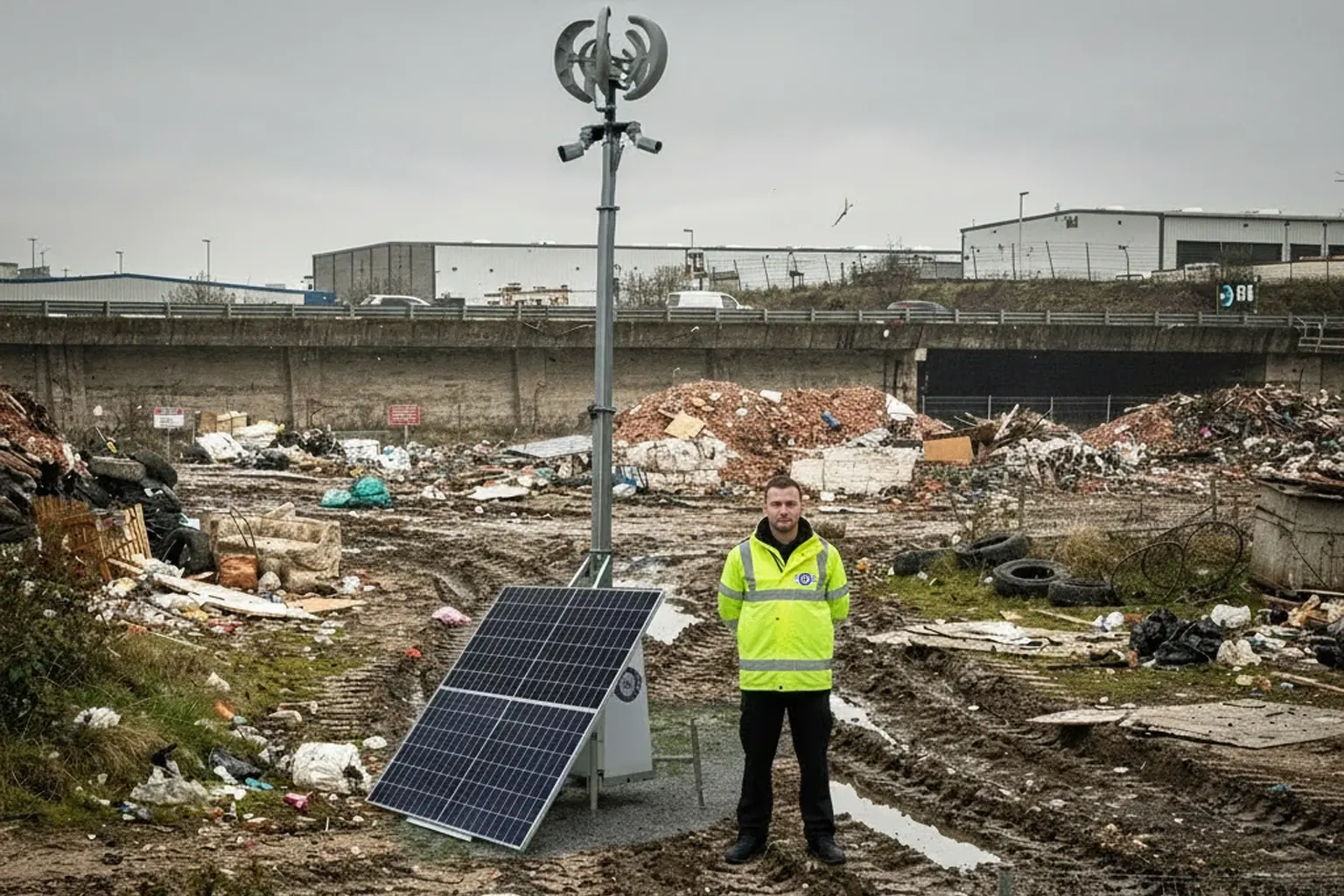
Deploying temporary CCTV towers or integrated mobile CCTV on site can:
- Capture time-stamped footage of vehicle movements
- Record number plates where lawful and appropriate
- Provide visual confirmation of any attempts to re-enter the site
- Act as a deterrent when combined with clear signage and visible guarding
Security teams can work with councils and enforcement partners to:
- Download and transfer footage securely
- Align incident logs with video clips (date, time, observation)
- Support the evidential needs of the Environment Agency and local authority investigations
This doesn’t replace formal enforcement work, but it adds another layer of intelligence and makes it harder for offenders to return unnoticed.
Protecting Contractors, Officers and Visitors to Site
Once an illegal waste site is under investigation, various professionals need to attend:
- Environmental consultants
- Surveyors and engineers
- Council officers and Environment Agency staff
- Specialist waste and remediation contractors
These teams may be working in:
- Physically hazardous conditions (unstable ground, sharp materials, fumes)
- Environments where there is a risk of confrontation (if offenders return to site or local tensions are high)
Security helps by:
- Controlling access while contractors are on site
- Checking the perimeter and keeping unauthorised visitors away
- Being a visible point of contact if there are any concerns or incidents
- Supporting lone working policies and emergency response plans
In short, security provides safe working conditions so the technical, legal and clean-up work can go ahead without unnecessary risk.
Structured Reporting and Clear Communication
Modern security isn’t just about standing at a gate; it’s also about good information.
At an illegal dump, that means:
- Daily or weekly incident reports, even if nothing significant happened (“nil reports” still show monitoring)
- Logs of attempted access, suspicious vehicles, fires, trespass or vandalism
- Photographic updates to show whether waste levels or site conditions are changing
- Quick escalation of urgent issues to the council’s nominated contacts
This structured reporting helps:
- Council managers brief elected members and senior leaders
- Communications teams provide updates to residents and the media
- Enforcement partners build a more complete picture of how the site is being used
Security Measures for Illegal Waste Sites, What We Provide & Why It Helps
| Security Measure | Primary Purpose | Benefit to Council & Community |
|---|---|---|
| Manned guarding at access points | Control who enters and leaves the illegal waste site | Reduces new illegal dumping, reassures residents that the site is monitored |
| Mobile CCTV tower / on-site cameras | Monitor vehicle movements and activity on site | Deters offenders, supports investigations with time-stamped visual evidence |
| Perimeter and internal patrols | Check fences, boundaries and high-risk areas | Reduces trespass, identifies hazards early (fires, instability, breaches) |
| Keyholding & controlled access for contractors | Manage gates and locks for authorised visits | Enables safe access for surveys and clean-up while keeping the site secure at other times |
| 24/7 incident reporting & escalation | Record and communicate incidents quickly | Helps councils respond rapidly to fires, break-ins or renewed illegal dumping |
| Community-facing presence | Act as a visible point of reassurance near the site | Shows residents that practical steps are being taken while long-term solutions are developed |
For councils facing pressure over illegal dumps UK-wide, security is not a silver bullet. But it is a practical, immediately deployable tool that:
- Stops the situation deteriorating
- Protects people who live and work nearby
- Buys time for complex investigations and remediation plans to progress
In the next section, we’ll turn this into practical guidance for councils and landowners, outlining the steps they can take right now to reduce risk, improve visibility and build a stronger response to illegal waste dumping in their areas.
Practical Guidance: What Councils and Landowners Can Do Right Now
Illegal waste dumping can feel overwhelming, especially when you’re faced with a large illegal dump or an entrenched illegal waste site that you didn’t create and can’t fix overnight. But there are still clear, practical steps councils and landowners can take to reduce risk, show visible action, and stop things getting worse.
This section breaks that down into two views:
- 11.1 For councils and public bodies
- 11.2 For private landowners, housing providers and developers
11.1 For Councils and Public Bodies
Councils are often on the front line of public frustration about illegal dumps in the UK, even when the land itself is privately owned or the Environment Agency is leading enforcement. Having a structured playbook helps.
Strengthen your early-warning system
- Map and monitor fly-tipping hotspots and emerging illegal dumps.
- Use existing reporting tools (online forms, apps, hotline) to capture:
- Location
- Type and volume of waste
- Any vehicle details (where safe to observe)
- Flag any site where:
- Incidents are increasing in frequency
- Loads are getting larger (tippers/HGVs)
- Waste composition is changing (more mixed, commercial or construction waste)
These are signs that a hotspot may be evolving into an illegal waste site and needs a different response.
Create a clear escalation route for suspected illegal waste sites
When a site moves beyond normal fly-tipping, it helps to have a defined escalation pathway:
- Identify a single internal lead (e.g. Environmental Crime or Environmental Health) for suspected illegal waste sites.
- Establish criteria that trigger:
- Early dialogue with the Environment Agency
- Multi-agency meetings with police where organised crime is suspected
- Consideration of temporary security measures (guarding, CCTV towers, patrols).
- Agree who is responsible for:
- Community communication
- Landowner contact
- Recording and sharing evidence
This avoids the “everyone and no one owns it” problem that can occur around complex illegal dumps.
Use security tactically, not as an afterthought
When you have a known illegal waste site or a high-risk hotspot, security works best when it’s:
- Brought in early enough to stop the site growing further
- Clearly briefed on:
- Access control rules
- Reporting lines and incident thresholds
- Any specific community sensitivities (near schools, farms, housing)
- Integrated into your multi-agency plan, not operating in isolation
Security should be seen as:
“A stabilisation tool that protects the public and site while we carry out the investigation and plan the long-term solution.”
Communicate with residents regularly
Communities around illegal dumps often feel left in the dark. Even short updates can make a difference:
Explain:
- Who is leading on the site (council, EA or joint)
- What stage you are at (investigation, legal work, security deployment, remediation planning)
Be honest about:
- Timescales, especially where funding or legal issues are involved
- What security can and cannot do
Provide:
- A simple way to report new dumping or suspicious vehicles
- Visible contacts (e.g. signage at or near the site)
11.2 For Private Landowners, Housing Providers and Developers
Sometimes the first person to discover an illegal dump is the landowner themselves, a farmer, an estate manager, a housing association or a developer.
Make high-risk land harder to access
Review boundaries at:
- Quiet field entrances and tracks
- Disused farmyards or outbuildings
- Vacant plots earmarked for future development
Consider:
- Gates, bollards or barriers at vehicle access points
- Repairing or upgrading broken fencing
- Installing clear “No tipping / CCTV in operation” signage
You don’t need to fortress your land, just remove easy opportunities that attract repeat illegal waste dumping.
Record and report early
If you find a new dump on your land:
Photograph it from safe positions, including:
- Overall view
- Any tyre tracks
- Distinctive items (branded waste, pallets, containers)
Report it promptly to:
- Your local council (for recording and advice)
- The Environment Agency if you suspect an ongoing illegal waste site or hazardous material
Keep your own log of:
- Dates and times of any new loads
- Vehicle descriptions or registrations (if safely observed)
- Any contact with suspected offenders
This record will be important if responsibility or enforcement action is being considered later.
Consider temporary security if activity is ongoing
If you see repeated illegal waste dumping or suspect your land is being targeted as an illegal waste site, it may be worth:
- Using a professional security provider to:
- Patrol vulnerable entrances
- Provide a visible presence at peak times
- Support CCTV or mobile tower deployment
- Working with the council to coordinate security, reporting and signage
- Combining security with physical measures (gates, concrete blocks, bunds) where appropriate and lawful
Even a short period of focused security can:
- Break the pattern of repeated dumping
- Gather useful intelligence on vehicles and timings
- Reassure neighbouring residents and businesses
Don’t ignore small incidents
The biggest mistake landowners and managers can make is to treat all incidents as “just a bit of rubbish”. Many entrenched illegal dumps UK-wide began with:
- A single trailer load at the back of a field
- A few piles of rubble down a track
- A “temporary” mound near a quiet industrial estate
If it’s not cleared, not reported and not visibly monitored, that “temporary” mound can be the start of a long-term illegal waste site with major consequences.
Frequently Asked Questions About Illegal Dumps and Illegal Waste Sites in the UK
What is an illegal waste site in the UK?
An illegal waste site is any location where waste is being deposited, stored, treated or disposed of without the required environmental permits or licences. Unlike one-off fly-tipping, an illegal waste site is usually:
Used repeatedly over time
Receiving multiple loads of waste
Operated by individuals or groups who profit from illegal waste dumping
These sites can range from informal tips in fields and woodlands to large-scale illegal dumps that resemble unregulated landfills.
How is an illegal dump different from normal fly-tipping?
Fly-tipping usually refers to one-off or occasional illegal dumping – for example, a load of rubbish pushed into a layby or a mattress left in an alley.
An illegal dump goes further. It typically involves:
Repeated tipping at the same location
A build-up of mixed waste (household, commercial, construction)
Waste piles that remain in place rather than being cleared
When this becomes regular and organised, the site is effectively functioning as an illegal waste site, not just a fly-tipping hotspot.
Used repeatedly over time
Receiving multiple loads of waste
Operated by individuals or groups who profit from illegal waste dumping
These sites can range from informal tips in fields and woodlands to large-scale illegal dumps that resemble unregulated landfills.
How common are illegal dumps in the UK?
Illegal dumping is widespread. In England alone, local authorities deal with over a million fly-tipping incidents every year, and thousands of those involve larger vehicle loads. On top of that, the Environment Agency shuts down hundreds of illegal waste sites each year, with many more suspected.
So when we talk about illegal dumps UK-wide, we’re not talking about isolated, rare events – we’re talking about a persistent pattern of waste crime affecting both urban and rural areas.
Who is responsible for clearing an illegal waste site?
Responsibility depends on a few factors:
Landowner – In many cases, the landowner is ultimately responsible for removing waste from their land, even if they were a victim of illegal waste dumping.
Local authority – Councils usually handle fly-tipping on public land and may take action where there is an immediate risk to the public.
Environment Agency – Leads on serious or large-scale illegal waste sites, and can require operators or landowners to clean up in certain circumstances.
In practice, clearing an illegal dump often involves joint working between the landowner, the council and the Environment Agency, particularly where the site is large, hazardous or linked to organised crime.
Why can’t councils just clear every illegal dump straight away?
Large illegal dumps and entrenched illegal waste sites are expensive and complex to clear. Councils and the Environment Agency may need to:
Confirm land ownership and legal responsibility
Assess environmental risks (contamination, asbestos, gases)
Secure funding for safe removal and disposal
Procure specialist contractors
On top of that, disposing of waste legally means paying landfill tax and gate fees, which can run into millions of pounds for large sites. That’s why councils often have to plan phased, carefully controlled clearance, rather than simply sending a crew the next day.
What are the main dangers of living near an illegal dump?
Living or working near an illegal waste site can pose several risks:
Odours and fumes from decomposing waste or fires
Increased pests such as rats, flies and seagulls
Potential smoke inhalation if fires occur on site
Stress and anxiety about long-term health and property value
Traffic and noise from vehicles accessing the site
Not every illegal dump will present the same level of hazard, but many residents report a significant impact on their quality of life and sense of safety.
How does illegal waste dumping affect councils and taxpayers?
Illegal waste dumping has a direct financial impact:
Councils spend millions of pounds each year dealing with fly-tipping and illegal dumps.
Money spent on clearing an illegal waste site cannot be used for other services like roads, parks or social care.
Legitimate waste businesses are undercut by criminals who avoid disposal costs, which distorts the market and ultimately hits the wider economy.
In short, illegal dumps UK-wide are paid for twice – once by the customers who thought they were paying for legal disposal, and again by taxpayers when public bodies have to help clean the mess up.
Who should I report illegal dumps or suspicious waste activity to?
If you suspect illegal waste dumping or discover an illegal dump, you should:
Contact your local council to report fly-tipping or a suspected illegal waste site.
Report serious or ongoing illegal waste operations, particularly those involving large volumes or hazardous materials, to the Environment Agency (in England) via their incident hotline.
If there is an immediate danger to life or serious crime in progress (e.g. aggressive behaviour, arson), call the police on 999 or 101 as appropriate.
Always avoid confrontation and do not put yourself at risk. If possible, safely note details like location, vehicle type/registration and time.
Can security guards really make a difference at an illegal waste site?
Yes. Security can’t replace enforcement or environmental regulation, but at a known illegal waste site it can:
Deter further illegal tipping by controlling access points
Provide a visible presence that reassures residents
Reduce trespass, arson and anti-social behaviour
Support investigations with incident logs and footage (where CCTV is used)
Make it safer for council staff, Environment Agency officers and contractors to work on site
In other words, security helps stabilise the site while longer-term legal and clean-up work takes place.
What kind of security measures are most effective for illegal waste sites?
Effective security around illegal dumps typically includes a combination of:
Manned guarding at entrances and key access routes
Mobile CCTV towers or cameras covering vehicle approaches and high-risk areas
Perimeter patrols to check for new breaches, fires or trespass
Keyholding and controlled access for authorised contractors and officials
Structured reporting so councils receive regular updates and incident alerts
The exact mix depends on the size, location and risk profile of the illegal waste site, as well as local community concerns.
What can landowners do to prevent illegal waste dumping on their land?
Landowners can reduce the risk of illegal dumps forming by:
Securing vulnerable entrances with gates, barriers or bunds where appropriate
Repairing damaged fences and closing off “informal” access tracks
Installing clear “No tipping / Private land” signage
Using CCTV or trail cameras in high-risk areas
Reporting the first signs of illegal waste dumping quickly, rather than waiting for it to grow
Early action is crucial. Many large illegal dumps began as a few loads in a quiet corner that were left unreported and unchallenged.
Is all illegal waste dumping linked to organised crime?
Not all illegal waste dumping is organised crime. Some fly-tipping is opportunistic – for example, individuals avoiding disposal fees or trips to a recycling centre.
However, many of the larger illegal dumps UK-wide, and almost all entrenched illegal waste sites, are linked to criminal enterprises that:
Take payment for collecting commercial or construction waste
Avoid the cost of legitimate disposal
Dump waste on land they do not own or control
That’s why tackling illegal waste is increasingly seen as part of the wider fight against organised crime and fraud, not just a nuisance issue.
What is being done nationally to tackle illegal waste dumping in the UK?
Nationally, efforts to tackle illegal waste dumping and illegal waste sites include:
Increased funding for enforcement and Environment Agency operations
Plans for digital waste tracking to monitor waste from producer to destination
Tighter rules around waste carrier registration and permit exemptions
Greater use of tools like vehicle seizures, fines and prosecutions
Support for councils to use technologies such as drones and mobile CCTV
These measures are designed to make it harder and riskier to operate illegal waste sites, while improving the traceability of waste across the whole system.
How can councils show they are taking illegal dumps seriously?
Councils can demonstrate a proactive response to illegal dumps and illegal waste sites by:
Responding quickly to reports and explaining what action is being taken
Working visibly with partners – Environment Agency, police, landowners and professional security providers
Using temporary security and CCTV where appropriate to stabilise high-risk sites
Communicating openly with residents about progress, constraints and next steps
Publishing clear routes for reporting illegal waste dumping and fly-tipping
Residents may not see every legal or technical step behind the scenes, but they will notice visible presence, regular updates and practical measures on the ground.