Why Martyn’s Law Matters for Hospitals
Hospitals and healthcare facilities are among the most complex and sensitive environments in the UK. They operate 24 hours a day, house some of the nation’s most vulnerable people, and manage enormous footfall across entrances, corridors, waiting rooms, treatment areas, car parks and public spaces. These sites must balance clinical care, emergency access, visiting traffic and essential services, all while maintaining a safe, open and trusted environment for the public.
This combination of openness and vulnerability makes hospitals a key focus of Martyn’s Law (the Terrorism Protection of Premises Act 2025). Unlike many other premises types, healthcare facilities cannot simply close their doors or evacuate a building in response to a threat. Patients may be undergoing surgery, receiving critical care, or unable to move. This makes preparedness, rapid communication and flexible lockdown/evacuation planning critical.
Martyn’s Law aims to raise the safety baseline across all publicly accessible sites, but for hospitals, the stakes are even higher. A well-prepared healthcare facility can protect patients, staff and visitors, minimise disruption to clinical operations, and prevent chaos in the event of a real attack. For hospital trusts, the Act is not just a compliance exercise, it is a vital component of patient safety, business continuity, and organisational resilience.
This guide explains exactly how Martyn’s Law applies to hospitals and healthcare settings, what the legal duties require, how to prepare, and how to implement practical, proportionate plans that work in challenging clinical environments. Whether you operate a major hospital, community clinic or healthcare campus, this resource will help you build a compliant and robust safety strategy.
Does Martyn’s Law Apply to Shopping Centres & Retail Parks?
Yes, Martyn’s Law applies to almost every hospital and most healthcare facilities in the UK. Because these environments are publicly accessible and routinely exceed the key capacity thresholds, they fall squarely within the scope of the Terrorism Protection of Premises Act 2025.
The Act applies to any premises that:
- Is publicly accessible,
- Has a capacity of 200 or more, and
- Operates as a place where the public can enter, gather, wait, receive services or move freely.
Hospitals, by design, meet these conditions. They have large entrances, busy waiting rooms, multiple public departments, and open access areas that support high volumes of footfall. Even smaller hospitals frequently exceed the 200–799 threshold, while medium and large general hospitals usually fall into the Enhanced Duty category (800+).
But Martyn’s Law does not stop at hospitals. Many other healthcare settings also qualify.
Healthcare Sites That Qualify Under Martyn’s Law
The Act is intentionally broad, covering a wide range of healthcare premises, including:
Hospitals
- General hospitals
- District hospitals
- Teaching hospitals
- Specialist centres (cancer, cardiac, orthopaedic, maternity, etc.)
- Children’s hospitals
- Acute care sites
- A&E departments (individual entrances often exceed capacity thresholds alone)
Healthcare Campuses & Multi-building Sites
- NHS Trust campuses
- Multi-block hospitals with shared public areas
- Health villages
Community Healthcare Facilities
- Walk-in centres
- Urgent care centres
- Outpatient clinics
- Diagnostic hubs
- Minor injury units
- Renal dialysis centres
- Blood donation centres
Mental Health Units
- Inpatient wards
- Trust headquarters
- Dual-access clinical buildings
- Secure facilities (with public areas such as receptions)
Private Healthcare Providers
- Private hospitals
- Private surgical day units
- Cosmetic clinics
- Fertility clinics
- Oncology centres
Primary Care, Case-by-Case Basis
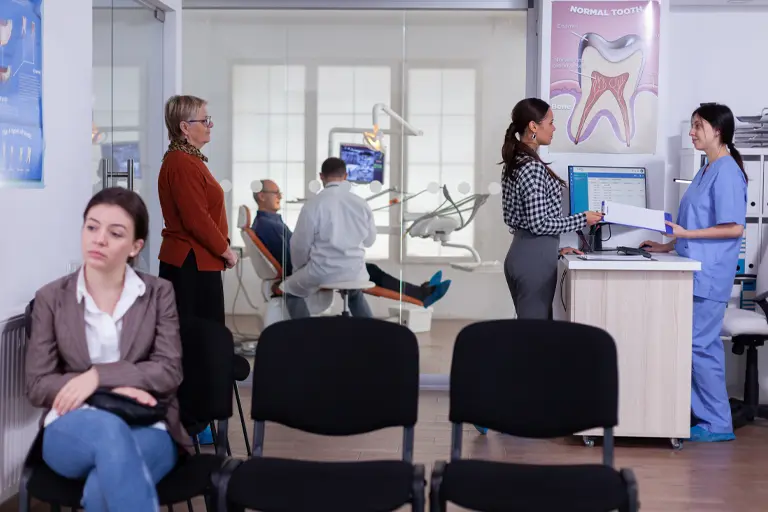
Premises such as GP surgeries, dental practices and opticians may only qualify if:
- Public capacity exceeds 200,
- Or they form part of a larger integrated healthcare site.
Standalone GP surgeries generally sit below the threshold, but a large medical centre with multiple practices may qualify.
Capacity Thresholds: Which Duty Applies?
The core distinction under Martyn’s Law is between Standard Duty and Enhanced Duty. Here’s how they apply to healthcare environments:
Standard Duty (Capacity 200–799)
Likely applies to:
- Small hospitals
- Community clinics
- Outpatient centres
- Medium-sized private hospitals
- Walk-in centres
- Urgent treatment centres
- Mental health units with public reception areas
- Multi-practice medical centres
Requirements include:
- Staff training
- Procedures for responding to attacks
- Basic security planning
- Reporting suspicious activity
- Evacuation/lockdown considerations
Enhanced Duty (Capacity 800+)
Almost all general hospitals fall into this tier.
Likely applies to:
- Regional hospitals
- Trust hospitals with A&E
- Specialist centres
- Children’s hospitals
- Large private hospitals
- Hospital campuses
- Multi-building sites with shared public space
Enhanced Duty requires:
- A Terrorism Risk Assessment (TRA)
- A full Emergency Security Plan (ESP)
- Testing & exercising requirements
- Strong documentation
- Evidence of governance
- Post-exercise reviews
- Coordination across departments and estates/security teams
Read our article: Martyn’s Law for Shopping Centres
Healthcare Facility Types vs Likely Martyn’s Law Tier
Healthcare Facility Types vs Likely Duty Tier (Preview, full HTML added later)
| Healthcare Facility Type | Typical Capacity | Likely Martyn’s Law Duty Tier |
|---|---|---|
| District General Hospital (DGH) | 1,000–5,000+ people on site | Enhanced Duty |
| Large City / Teaching Hospital | 3,000–10,000+ people on site | Enhanced Duty |
| Community Hospital / Cottage Hospital | 200–700 people on site | Standard Duty |
| Walk-In Centre / Urgent Treatment Centre (UTC) | 100–500 people on site | Standard Duty |
| GP Practice / Medical Centre | 20–200 people on site | Out of Scope (Too small) |
| Private Hospitals (e.g., BMI, Spire, Nuffield) | 200–900 people on site | Standard Duty (Some may reach Enhanced) |
| Mental Health Hospitals / Secure Units | 100–600 people on site | Standard Duty |
| Rehabilitation Centres / Specialist Clinics | 50–300 people on site | Standard Duty |
| Dental Hospitals / Outpatient Complexes | 200–700 people on site | Standard Duty |
Areas Within Hospitals That Are Automatically in Scope
Even if a hospital tried to argue against capacity (they can’t), certain parts are unequivocally publicly accessible and meet the definitions:
- Main entrances
- A&E reception
- Outpatient waiting areas
- Maternity reception and waiting rooms
- Cafes and retail spaces
- Car parks
- Hospital atriums
- Main corridors linking public-facing wards
These alone often approach or exceed 200–400 people during routine operation.
Key Takeaway
Martyn’s Law applies to almost every hospital in the UK and many healthcare facilities.
Most general hospitals will fall under Enhanced Duty, meaning they require detailed risk assessments, emergency security plans and testing programs.
Healthcare organisations cannot assume they are exempt, nor can they rely solely on fire procedures or clinical emergency plans. This Act introduces new legal obligations that demand dedicated security thinking, cross-team cooperation and documented resilience strategies.
Unique Risks in Healthcare Environments
Hospitals and healthcare sites face security challenges that are significantly different from retail, hospitality, offices or public venues. These environments are inherently open, complex, emotionally charged and unpredictable, making them uniquely vulnerable to terrorism and hostile intent. Martyn’s Law recognises these risks and requires hospitals to put in place tailored, proportionate protections that reflect the realities of clinical care.
Below are the core risks that make healthcare facilities a priority environment for enhanced preparedness.
High Concentration of Vulnerable People
Unlike most premises covered by Martyn’s Law, hospitals house:
- Patients who cannot walk or move
- Individuals undergoing surgery or treatment
- Elderly or disabled patients
- Urgent and emergency cases
- People reliant on life-supporting equipment
- Staff who must prioritise clinical care over physical evacuation
This means a full building evacuation, which is possible in retail, hotels or offices, is not feasible in hospitals. Any security incident must consider mobility, dependency and the critical nature of ongoing treatment.
24/7 Public Access and Constant Footfall
Healthcare sites rarely stop operating. Hospitals experience:
- Round-the-clock visitation
- High volumes of A&E walk-ins
- Shift changes involving hundreds of staff
- Deliveries, contractors and ambulance arrivals
- Continual public movement through corridors
The continuous flow of people makes controlled access challenging and increases vulnerability to:
- Hostile reconnaissance
- Tailgating/unauthorised entry
- Opportunistic attacks
- Vehicle-borne threats
Martyn’s Law requires hospitals to manage these risks through proportionate public protection procedures and improved awareness.
Large, Complex, Multi-Zone Layouts
Hospitals are often made up of:
- Multiple buildings
- Bridge-linked structures
- Long public corridors
- Mixed-use wards
- Public cafés and shops
- Car parks
- Shared entrances
This makes identifying “publicly accessible” zones more complex and can complicate emergency responses.
Attackers typically target:
- A&E entrances
- Crowded waiting areas
- Reception zones
- Cafés and shops
- Car parks and drop-off bays
Because these are naturally high-footfall and less controlled.
Hospitals Cannot Fully Evacuate During Most Threats
Hospitals must be prepared for:
- Evacuation
- Lockdown
- Partial evacuation
- Protect-in-place strategies
Many departments, such as ICU, maternity, theatres, dialysis, and neonatal units, cannot be moved without severe risk to life. This means hospitals require:
- Pre-defined alternative routes
- Ward-level lockdown capability
- Department-specific action plans
- Faster internal communications systems
This complexity is why Martyn’s Law obliges Enhanced Duty hospitals to develop detailed, department-specific Emergency Security Plans (ESPs).
Emotional and High-Stress Environments Increase Unpredictability
Hospitals experience unique pressures that can escalate security risk:
- High-emotion situations (bereavement, trauma, emergencies)
- Extended waiting times
- Aggressive behaviour
- Mental health incidents
- Substance misuse
- Domestic or gang-related spillover incidents
These can distract staff, overwhelm reception areas, and expose security gaps that an attacker could exploit.
Open and Trusted Public Image
Unlike a stadium or secure office, hospitals must remain:
- Welcoming
- Accessible
- Approachable
This positioning, while essential, also makes them vulnerable to:
- Unrestricted public access
- Insider threats
- Coaching by attackers during reconnaissance
- Lack of suspicion around visitors
Staff awareness and public protection training become essential to counter this.
High Dependency on Emergency Access Routes
Hospitals rely heavily on:
- Ambulance bays
- Drop-off points
- Blue-light access roads
- Helipads
- Supply roads
These are critical lifelines. They also create vulnerabilities:
- Vehicle-as-a-weapon attacks
- Blocking or ramming access routes
- Attacks targeting ambulance queues
- Dropped devices in high-traffic zones
Martyn’s Law encourages hospitals to assess and mitigate these vehicle-related risks.
High Staff Turnover & Temporary Staff Usage
Hospitals frequently employ:
- Agency nurses
- Locum doctors
- Contractors
- Temporary cleaning/catering staff
- Visiting specialists
This creates challenges:
- Consistent training
- Shared situational awareness
- Documentation of responsibilities
- Ensuring all personnel understand public protection procedures
Regular onboarding and simple, accessible training tools are therefore essential.
Key Takeaway
Hospitals face a unique blend of clinical, operational and public-access risks. These environments require security solutions that:
- Never compromise patient care
- Allow for flexible evacuation or lockdown
- Support continuous operations
- Integrate with existing emergency and clinical procedures
- Work across large, complex, multi-zone buildings
Martyn’s Law provides the framework, but hospitals must translate it into real, practical, and clinically safe actions.
Read our article: Martyn’s Law for Hotels
| Requirement | Included Under Standard Duty? | Retail-Specific Notes |
|---|---|---|
| Basic Terrorism Protection Plan (TPP) | Required | Simple, practical plan covering evacuation, lockdown & communication. |
| Basic staff awareness training | Required | Must include retail workers, cleaners, security, and seasonal staff. |
| Evacuation & lockdown procedures | Required | Particularly important for open-fronted stores & food courts. |
| Terrorism Risk Assessment | Not Required | This is only for Enhanced Duty centres. |
| Mandatory security equipment | Not Required | No need for scanners, bollards, gates, etc. under Standard Duty. |
Standard Duty Requirements for Healthcare Sites (200–799 Capacity)
Some healthcare facilities, such as community hospitals, urgent treatment centres, walk-in clinics, outpatient hubs and medium-sized private hospitals, fall into the Standard Duty level of Martyn’s Law. Although this is the lower tier of legal responsibility, the requirements remain critical for settings where vulnerable individuals, staff and visitors rely on rapid and coordinated responses to security threats.
Standard Duty is designed to provide a minimum level of preparedness that improves public safety without introducing operational disruption. For healthcare sites, it ensures that staff can recognise suspicious activity, follow clear procedures and respond confidently during an incident, all while continuing to prioritise patient care.
Below is a detailed explanation of what Standard Duty means in a hospital or healthcare environment.
What Standard Duty Requires in Healthcare Settings
Standard Duty has five core legal requirements, all of which apply to any healthcare facility with a public capacity of 200–799 people.
Basic Terrorism Awareness Training for Staff
Healthcare staff must understand:
- What suspicious behaviour looks like
- What suspicious items look like
- How to report concerns quickly
- How to respond during a threat
- Simple lockdown or evacuation instructions
- How their specific role fits into wider procedures
Training does not need to be intensive. It must be:
- Simple
- Consistent
- Easily accessible
- Suitable for clinical and non-clinical staff
Hospitals may need different versions for:
Nurses, receptionists, security teams, cleaners, porters, volunteers, contractors and administrative staff.
Clear Public Protection Procedures (PPPs)
Healthcare sites must have clearly documented procedures covering:
- How to handle suspicious items
- How to report suspicious behaviour
- How to respond to a threat
- How to communicate with staff, patients and visitors
- Whether lockdown or evacuation is preferred in each public area
These procedures must be:
- Written
- Shared
- Understandable
- Relevant to how the building operates
In healthcare settings, PPPs must align with:
- Fire procedures
- Clinical emergency protocols
- Major incident plans
- Existing hospital security guidance
Evacuation and Lockdown Considerations
Standard Duty hospitals must have procedures that outline:
- When to evacuate
- When to lock down
- When to use “protect in place” as an alternative
- How to move people who cannot self-evacuate
- Who makes decisions during an incident
- How they will communicate instructions to staff
Because healthcare environments include wards, treatment rooms and dependency-related risks, these procedures need careful tailoring.
A Named Responsible Person
Every healthcare site must designate a Responsible Person for Martyn’s Law compliance.
This person must ensure:
- Staff receive training
- Procedures are created, updated and followed
- Risks are monitored
- Documentation is accessible
- Communication pathways are clear
In healthcare, this typically sits with:
- Head of Security
- Head of Estates & Facilities
- Operational Director
- Risk & Governance Manager
- Trust Board Representative
Reporting Concerns & Incident Communication
All sites covered by Standard Duty must demonstrate the ability to:
- Receive and pass on security alerts
- Quickly communicate across departments
- Mobilise evacuation or lockdown orders
- Report suspicious behaviour internally and externally
- Coordinate with emergency services
Hospitals should align this requirement with:
- Existing critical incident alert systems
- Ward communication tools
- PA or Tannoy systems
- Internal radio channels
- Secure messaging platforms
Clear pathways must be documented and rehearsed.
What Standard Duty Does Not Require
Healthcare sites under Standard Duty do not need:
- A full terrorism risk assessment
- A full emergency security plan
- Recorded testing or exercising
- Formal governance structures
- Complex documentation
- Annual audits
However, many hospitals choose to implement some Enhanced Duty practices voluntarily because they significantly improve resilience.
4Why Standard Duty Still Matters to Healthcare Facilities
Although Standard Duty is comparatively light touch, it plays a major role in the healthcare sector by providing:
A consistent baseline of staff awareness
This is especially important in hospitals with:
- High turnover
- Agency staff
- Temporary contractors
- High visitor numbers
Clear procedures that reduce panic
Healthcare sites become chaotic very quickly during emergencies.
PPPs help calm staff and improve response efficiency.
A legally defined framework for public protection
This strengthens accountability and ensures security is no longer an afterthought.
Better coordination with emergency services
Clear procedures make responses faster and more effective.
Reduced liability for NHS Trusts and private operators
Proper compliance significantly reduces organisational risk.
Key Takeaway
Standard Duty healthcare facilities must focus on:
- Raising staff awareness
- Creating simple public protection procedures
- Ensuring staff know how to report concerns
- Establishing clear evacuation/lockdown actions
- Assigning a Responsible Person
Although Standard Duty is less demanding than Enhanced Duty, it forms the essential security baseline that all healthcare environments need, regardless of size or complexity.
Strengthen Your Hospital’s Security Today
Your Hospital’s Preparedness Starts Here
,p>Hospitals face some of the UK’s most complex security challenges. Our specialist team helps Trusts and healthcare operators build compliant, clinically safe emergency plans — including TRA development, ESP creation, staff training, and full implementation support.Enhanced Duty Requirements for Hospitals (Most Will Fall Here)
Most UK hospitals, especially general hospitals, Trust-operated sites, major treatment centres, maternity hospitals and teaching hospitals, will fall under the Enhanced Duty level of Martyn’s Law. This is due to their large capacity, extensive public areas and high daily footfall, often exceeding thousands of people across entrances, corridors, wards, waiting rooms and outpatient zones.
Enhanced Duty applies to any publicly accessible premises with a capacity of 800 or more, meaning that most hospitals are legally required to meet significantly higher standards of security preparedness, planning and documentation than smaller healthcare facilities.
Enhanced Duty is designed to ensure that large, complex environments have:
- A documented understanding of their risks
- A structured emergency security plan
- Trained and capable staff
- Clear communication pathways
- The ability to respond rapidly and proportionately
- Evidence of testing and exercising
For hospitals, this is not optional, it is mandatory, enforceable and essential for operational resilience.
Below is a full breakdown of what Enhanced Duty requires in a healthcare context.
The Three Core Components of Enhanced Duty
Enhanced Duty introduces three major legal obligations for hospitals:
- A full Terrorism Risk Assessment (TRA)
- A detailed Emergency Security Plan (ESP)
- Testing and exercising to prove the plans are effective
Each obligation must be properly documented, reviewed and managed by designated personnel.
Terrorism Risk Assessment (TRA) for Hospitals
A TRA is a structured, documented assessment that identifies:
- Vulnerabilities
- Likely attack methods
- High-risk areas
- Operational weaknesses
- Visitor/footfall patterns
- Existing mitigations
- Gaps requiring action
For hospitals, this assessment must be far more detailed than in other sectors because:
- Evacuation is not always possible
- Many patients cannot move
- Clinical care continues during crises
- Access routes must stay open for emergency services
- There are multiple public-facing entrances
- Staff work across hundreds of different rooms and wards
A hospital TRA typically includes:
Key Risk Areas Identified
- A&E entrances
- Reception and atriums
- Public waiting areas
- Cafés, restaurants and retail spaces
- Multi-storey car parks
- Ambulance bays
- Drop-off zones
- Outpatient departments
- Lift lobbies and main corridors
- Public toilets and staircase access points
- Pedestrian walkways between buildings
Common Threat Types
- Vehicle-as-a-weapon attacks
- Marauding terrorist attacks
- IEDs (Improvised Explosive Devices)
- Hostile reconnaissance
- Insider threats
- Threats to emergency access routes
- Abandoned bags/devices
- Lone-actor attacks
The TRA forms the foundation for the Emergency Security Plan, making it a critical legal requirement.
The Emergency Security Plan (ESP)
The ESP is the central document that explains how the hospital will respond to different types of terrorist incidents. For Enhanced Duty premises, the ESP is mandatory and must be proportionate to the complexity of the hospital.
A hospital-level ESP typically includes:
Roles and Responsibilities
Including:
- Chief Executive or Trust Board
- Head of Security
- Head of Estates & Facilities
- Senior Clinical Leaders
- Ward Managers
- Control room teams
- Reception staff
- Security officers
Communication Pathways
Hospitals must document:
- How alerts will be issued
- How to communicate silently if needed
- How to notify wards
- How to contact emergency services
- Who escalates decisions
- How to coordinate across buildings
This includes:
- PA/Tannoy systems
- Radios
- Secure messaging platforms
- Bleeps/pagers
- Emergency phones
- Secure digital alerts
Lockdown Procedures
Hospitals need multi-layered lockdown options, such as:
- Site-wide lockdown
- Building lockdown
- Ward lockdown
- Theatre/ICU lockdown
- Reception shield protocols
- Protect-in-place for non-mobile patients
Lockdown in a hospital is highly complex and must not jeopardise patient safety. Plans must reflect clinical realities.
Evacuation Procedures
Evacuation is still required for certain threats, but must be:
- Partial
- Phased
- Clinically appropriate
- Based on mobility and dependency levels
- Risk-assessed by ward
Plans must identify:
- Primary and secondary routes
- Clinical priorities
- Staff required for assisted evacuation
- Mobility equipment
- Safe zones
Coordination with External Agencies
Hospitals must define how they will work with:
- Police
- Counter-terrorism teams
- Fire and rescue
- Emergency planners
- Mutual aid partners
- Adjacent facilities
Medical and Clinical Continuity
The ESP must consider:
- Ongoing surgeries
- Critical care and ICU
- Neonatal and maternity units
- Oncology treatments
- Mental health wards
- Haemodialysis sessions
- Fracture clinics
- Emergency operations
Not all clinical activity can stop; the ESP must reflect this.
Public Information and Visitor Communication
Hospitals must document:
- How to direct visitors
- How to share real-time instructions
- How to manage panic
- What messaging is used
- Which areas can act as temporary safe zones
Testing, Exercising & Continuous Improvement
Enhanced Duty sites must prove their procedures work by conducting:
- Tabletop exercises
- Internal lockdown tests
- Partial evacuation drills
- Department-by-department testing
- Out-of-hours simulations
- Multi-agency exercises with police
These tests must be:
- Planned
- Documented
- Evaluated
And the ESP must be updated after each significant drill or incident.
Hospitals must also store an audit trail demonstrating compliance.
Required Documentation for Enhanced Duty Hospitals
Hospitals must maintain:
- TRA reports
- ESP documentation
- Training logs
- Exercise records
- Decision logs
- Communication protocols
- Governance structures
- Site maps and access plans
- Risk summaries
- Review records
This documentation is mandatory and must be produced upon request by the regulator.
Key Takeaway
Enhanced Duty places significant legal responsibility on hospitals. But it also gives them a structured framework for managing complex risks, protecting vulnerable people and ensuring continuity of care during major emergencies.
Most hospitals will fall under Enhanced Duty, meaning they must:
- Carry out a detailed Terrorism Risk Assessment
- Create a tailored Emergency Security Plan
- Test and exercise their plan regularly
- Maintain evidence of compliance
This section positions Leisure Guard as a specialist capable of supporting NHS Trusts and private hospitals through this entire process.
Evacuation & Lockdown in a Healthcare Setting
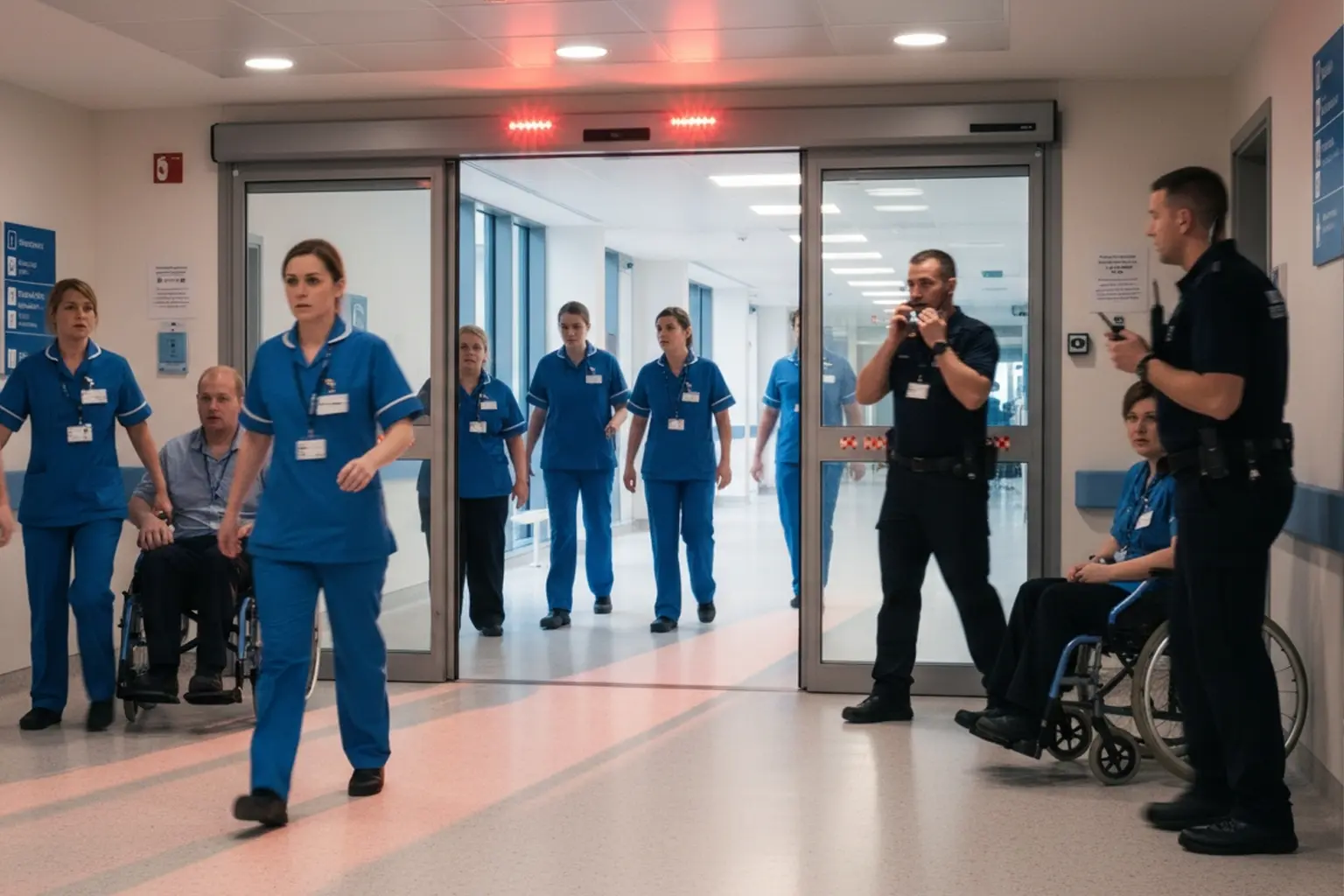
Evacuation and lockdown procedures are at the heart of Martyn’s Law, but hospitals face unique and often conflicting challenges that make them fundamentally different from other premises. In retail, hospitality or offices, a full evacuation is almost always the preferred response. In a hospital, however, hundreds of patients cannot be moved safely or quickly, and clinical care cannot simply stop.
This makes evacuation, lockdown and protect-in-place strategies far more complex in healthcare environments. Hospitals must be ready to combine all three response types depending on the threat, the location, the clinical environment and the mobility of patients.
Why Evacuation Is More Complex in Hospitals
Many hospital departments simply cannot evacuate without putting lives at risk. These include:
- Intensive Care Units (ICU)
- Coronary and cardiac units
- Operating theatres
- Neonatal units (NICU/SCBU)
- Dialysis wards
- Oncology infusion suites
- High-dependency units
- Trauma bays
Even in departments that can evacuate, the process is slower and requires more staff coordination than in other sectors.
Key challenges include:
- Patients on ventilators
- Patients with mobility impairments
- Patients undergoing surgery
- Medication and equipment dependencies
- Vulnerable groups (children, elderly, distressed)
- Logistical challenges with escorts and equipment
This complexity requires carefully designed evacuation procedures, backed by rehearsed staff actions.
Lockdown: The More Common Response in Hospitals
In many terrorist threat scenarios, lockdown is safer and more practical than evacuation. Hospitals must be able to:
- Restrict access quickly
- Secure public-facing areas
- Protect high-risk zones (A&E, maternity, reception)
- Move staff and patients away from exposed areas
- Avoid bottlenecks where crowds gather
- Isolate wards and theatres
- Maintain continuity of care
Hospitals may need multi-layered lockdown actions, such as:
- Site-wide lockdown: preventing entry and exit
- Building lockdown: isolating a specific building
- Department lockdown: securing A&E, paediatrics, maternity, etc.
- Ward-level lockdown: preventing movement in/out of clinical rooms
- Protect-in-place: safest option for non-mobile patients
This flexibility must be built into the Emergency Security Plan.
Protect-in-Place for Non-Mobile Patients
For many patients, moving them could worsen their condition or be physically impossible. Protect-in-place allows staff to:
- Close ward doors
- Draw blinds and curtains
- Reduce visibility
- Move patients away from windows and entrances
- Shut down adjacent corridors
- Stand down non-essential activity
Protect-in-place is often the correct response for:
- ICU and HDU patients
- Post-operative patients
- Complex cardiac cases
- Neonatal patients
- Individuals attached to life-supporting equipment
Hospitals must document when protect-in-place should be used instead of evacuation or lockdown.
Ward-Level Decision Making
Wards are clinically autonomous spaces with their own staff, procedures and patient groups. In an emergency:
- Not every ward will do the same thing
- Some may need to evacuate
- Some may need to lockdown
- Some may protect-in-place
This decentralisation must be accounted for in the ESP, and staff must know exactly what action applies to their area.
Ward managers need:
- Department-specific instructions
- Clear communication pathways
- Ability to escalate decisions
- A mapped understanding of escape routes
The Role of A&E in Evacuation and Lockdown
A&E is the most vulnerable zone in any hospital:
- High footfall
- Open access
- Emotional and unpredictable environment
- Queueing and congestion
- Limited ability to control visitors
A&E may require its own tailored plans, such as:
- Immediate A&E lockdown
- Redirecting ambulances
- Securing triage areas
- Closing public entrances
- Internal relocation of patients
Because A&E is a known high-risk target, it must be a major part of the site’s Emergency Security Plan.
Public Areas Create Additional Challenges
Entrances, lobbies, corridors, cafés and waiting rooms accumulate people quickly and offer multiple access points for attackers. During an incident, hospitals must:
- Prevent bottlenecks
- Avoid crowd panic
- Sweep public areas
- Secure staff-only routes
- Direct crowds safely
This requires staff training and clear visitor communication protocols.
Stairwells, Lifts and Corridors Must Be Planned
Hospitals must pre-assess:
- Primary evacuation routes
- Secondary (fallback) routes
- Lift restrictions during incidents
- Stairs as high-traffic or high-risk areas
- Corridor choke points
- Areas where patients may require escort teams
Without this planning, evacuation can become chaotic.
Evacuation vs Lockdown: Hospital Comparison Table
| Hospital Area | Evacuate? | Lockdown? | Protect-in-Place? | Notes |
|---|---|---|---|---|
| Accident & Emergency (A&E) | Sometimes | Frequently | Rarely | High-risk public zone. Often locked down while patients are moved deeper into the department. |
| Outpatient Departments | Yes (where safe) | Sometimes | Sometimes | Generally suitable for evacuation, but may move to lockdown or protect-in-place depending on threat location. |
| General Wards | Sometimes | Yes | Yes | Decision guided by patient mobility and threat proximity. Often a mix of ward lockdown and protect-in-place. |
| Operating Theatres | Rarely | Yes | Yes | Evacuation is usually unsafe mid-surgery. Theatres typically move into lockdown and protect-in-place. |
| ICU / HDU | No | Yes | Yes | Highly dependent patients. Lockdown and protect-in-place are the primary responses in most scenarios. |
| Maternity / Neonatal Units | Sometimes | Yes | Yes | Case-by-case basis. Vulnerable mothers and babies often require protect-in-place with strong lockdown controls. |
| Public Cafés / Shops | Yes | Sometimes | Rarely | Generally evacuated unless the threat is too close. May be locked down temporarily while areas are secured. |
| Main Entrances / Lobbies | Yes | Yes | No | High footfall areas. Often evacuated quickly and then locked down to prevent further entry. |
| Car Parks & External Areas | Yes | No | No | Usually lower density but vulnerable to vehicle-based threats. Evacuation and perimeter control are typical responses. |
Key Takeaway
Hospitals cannot rely on a single emergency strategy. Terrorist threats may require:
- Evacuation of some departments
- Lockdown of others
- Protect-in-place for critical care areas
- Coordination between clinical and security teams
- Clear communication across the entire site
This level of complexity is exactly why Enhanced Duty applies to most hospitals, and why the Emergency Security Plan must be detailed, rehearsed and understood by everyone.
Communication Systems for Hospitals
Clear, reliable and rapid communication is the backbone of an effective response under Martyn’s Law. In hospitals, communication must work across multiple buildings, hundreds of departments, complex layouts, and a 24/7 workforce. It must also support clinical care, maintain patient safety and reach the right staff instantly, even during high-stress, chaotic incidents.
Because hospitals often cannot fully evacuate during an attack, communication systems become even more critical. They determine whether departments lock down, evacuate or protect-in-place, and how quickly these actions occur.
Hospitals must therefore build communication strategies that are multi-layered, resilient, clinically safe and capable of operating under pressure.
Why Communication Is More Complex in Hospitals
Hospitals have:
- Diverse staff roles (clinical, admin, estates, security, porters, contractors)
- Large visitor footfall
- Thousands of patients with different care needs
- Multiple public entrances
- Separate and sometimes disconnected buildings
- A mixture of old and modern infrastructure
- Varied communication technologies
- Multiple shift patterns and rotations
- Out-of-hours staffing challenges
This complexity means no single communication method is sufficient. Hospitals must rely on multiple simultaneous systems.
Core Communication Channels Required Under Martyn’s Law
Public Address (PA) / Tannoy Systems
Hospitals need the ability to:
- Broadcast site-wide or building-specific messages
- Deliver clear emergency instructions
- Activate lockdown or evacuation notices
- Direct visitors away from danger
- Override background music or announcements
PA systems must be:
- Audible over hospital noise
- Clear in corridors and waiting areas
- Available during power disruptions
Two-Way Radios (Security, Porters, Clinicians, Estates)
Radios allow instant communication between:
- Security officers
- Porters
- Clinical teams (especially A&E and wards)
- Estates & Facilities
- Fire response teams
- Incident control rooms
Hospitals may need separate channels for:
- Security
- Emergency response
- Clinical teams
- Estates
- Coordination teams
Radios must be tested frequently and reach all buildings.
Silent Alert Systems for Sensitive Areas
Certain zones, such as paediatrics, maternity, ICU and theatres, cannot use loud alarms. Silent or discreet alerts may include:
- Secure messaging apps
- Alert beacons
- Staff-only screens
- Coded phrases
- Pagers/bleepers
These systems reduce panic and maintain clinical safety.
Internal Phone Systems & Emergency Extensions
Hospitals often use:
- Dedicated emergency hotlines
- Direct lines to security
- Internal extensions for ward escalation
- Theatre-to-security communication
These must be listed in the Emergency Security Plan and well publicised.
Staff Messaging Platforms
Hospitals are increasingly using:
- Secure mobile apps
- Digital pagers
- Instant messaging tools
- Emergency broadcast notifications
These allow fast alerts to:
- Ward managers
- Department leads
- Senior clinical staff
- Out-of-hours on-call teams
Visitor Communication Systems
Hospitals must plan how they will inform visitors during incidents:
- Digital screens
- Announcements
- Printed signage
- Marshals directing movement
- Controlled communication at reception
- Public messaging for car parks
Visitor communication is essential to avoid panic and prevent bottlenecks.
Role-Specific Communication Needs
Clinical Staff
Need quick instructions that don’t disrupt patient care, including silent alerts for sensitive departments such as:
- ICU
- NICU
- Theatres
- Maternity
- Oncology
Security Teams
Need:
- Constant radio contact
- Real-time threat information
- Ability to initiate lockdown
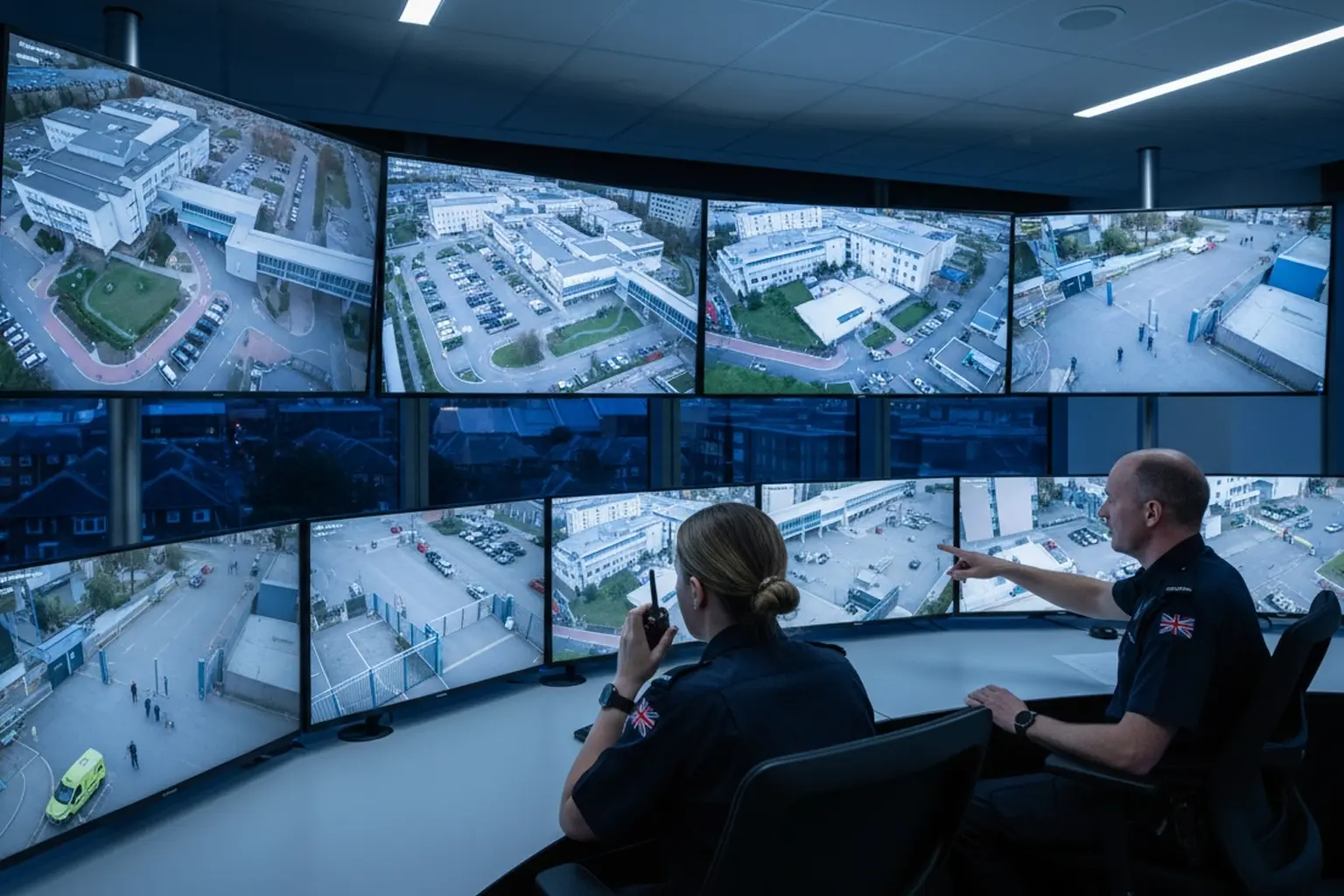
- Visibility of CCTV feeds
- Clear escalation routes
Estates & Facilities
Must coordinate:
- Door locking systems
- Access controls
- Alarms
- Barrier systems
- Power overrides
Reception, Admin & Volunteers
Need to:
- Direct patients and families
- Stop entry to closed areas
- Redirect people safely
- Communicate changes quickly
Integration with Technical Systems
Hospitals may integrate communication with:
- Building Management Systems (BMS)
- Fire alarm control panels
- Access control locking
- CCTV
- Panic alarm points
- Mass-notification systems
- Automatic door mechanisms
This enables coordinated, automated responses such as:
- Automatic lockdown of certain doors
- Immediate alerts to security
- Simultaneous notifications to clinical staff
- Visual cues on ward screens
Testing and Resilience Requirements
Under Enhanced Duty, hospitals must test communication pathways during drills.
This includes:
- PA announcements
- Radio coverage
- Silent alerts
- Incident control room communication
- Out-of-hours communication tests
- Activation of lockdown notifications
- Backup communication pathways
Hospitals must also have fallback methods for:
- Power outages
- Network failures
- Radio dead spots
- Unreachable staff
Key Takeaway
Hospitals require layered, resilient, multi-channel communication systems capable of reaching staff and the public quickly during a terrorist incident. Martyn’s Law requires these systems to be clearly documented, consistently tested and fully integrated with the hospital’s Emergency Security Plan.
Need Help Creating Your Emergency Security Plan?
strong>Get a Fully Compliant ESP Tailored to Your Site
A generic emergency plan won’t meet Martyn’s Law requirements — your hospital needs a tailored, risk-based approach designed around patient mobility, zoning, clinical operations and public footfall. We create clear, actionable ESPs that integrate seamlessly with existing NHS frameworks.
Staff Training Requirements for Healthcare Facilities
Hospitals are among the most complex staffing environments in the UK. They operate 24 hours a day, have thousands of employees, and depend heavily on temporary, agency and multi-disciplinary staff. This makes Martyn’s Law training requirements both critical and challenging.
Under both Standard and Enhanced Duty, hospitals must ensure that staff receive appropriate terrorism awareness training. Enhanced Duty hospitals (which includes almost all large hospitals) must go further by integrating training into governance structures, clinical operations, and multi-department coordination.
Training must be simple, proportionate and tailored to clinical realities, but it must be effective enough to change behaviour, improve awareness and save lives in an emergency.
Why Training in Hospitals Is More Complex
Hospitals have:
- Thousands of staff across multiple disciplines
- Constant shift rotations
- A high volume of agency and temporary workers
- 24/7 operations
- Volunteers and third-party contractors
- Public and private spaces
- Highly varied risk zones
This makes consistent training delivery challenging. Staff may work in:
- Wards
- A&E
- Outpatient areas
- Labs
- Imaging departments
- Theatres
- Administration
- Catering
- Security
- Estates
- Mental health units
Each group needs a tailored level of understanding.
Core Training Requirements (All Hospital Staff)
Regardless of role, all staff must be trained in:
Identifying suspicious behaviour
Including:
- Loitering
- Unusual interest in layouts, entrances, CCTV
- Attempts to avoid security
- Inappropriate clothing
- Repeated visits without reason
Identifying suspicious items
Such as:
- Unattended bags
- Items left in unusual locations
- Bags placed deliberately near crowded areas
How to report concerns
Hospitals must specify:
- Who to call
- Which number to use
- Whether to alert security first or clinical leads
- When to escalate to counter-terrorism teams
What to do during an incident
Staff must understand:
- Whether to lockdown, evacuate or protect-in-place
- How to communicate silently when needed
- How to support patient safety
- How to avoid moving towards danger
Their specific responsibilities
Every role has a different function in an incident.
Training Requirements for Clinical Staff
Clinical teams must receive training that aligns with patient care duties.
Training includes:
- Protecting patients during lockdown
- Moving mobile patients away from risk
- Safe evacuation procedures
- Preparing wards for protect-in-place
- Communicating calmly with the public
- Managing panic in vulnerable groups
- Ensuring medication and equipment safety
Clinical staff often take leadership roles during incidents, so training must be role-specific and scenario-based.
Training Requirements for Security Staff
Security officers require:
- Advanced suspicious behaviour recognition
- Counter-terrorism awareness (CTAW)
- Radio communication protocols
- Response sequencing (lockdown → sweep → secure)
- Identifying hostile reconnaissance
- External patrol awareness
- A&E-specific safeguarding
- Corridor control techniques
- Managing evacuation routes
- Managing vehicle threats
Security staff should also participate in multi-agency exercises.
Training for Reception, Admin, Volunteers & Front-Facing Teams
These are often the first to encounter suspicious behaviour.
Training must include:
- De-escalation skills
- Visitor direction and crowd management
- Reporting routes
- How to close entrances quickly
- Preventing tailgating
- Safety protocols for abandoned items
- Understanding lockdown procedures
Front-facing staff often manage public panic, so communication training is essential.
Training for Estates & Facilities Teams
They must understand how to:
- Secure doors and access points
- Support lockdown procedures
- Assist with evacuation route controls
- Communicate with the command centre
- Provide technical support
- Override systems where needed
- Coordinate with emergency services
Estates staff often play a crucial role during drills and real incidents.
Training for Porters & Support Services
Porters may need to:
- Move vulnerable patients
- Assist with evacuations
- Provide equipment during incidents
- Support clinical teams in theatres or wards
- Respond rapidly under instruction
Their training must be practical and scenario based.
Agency, Locum & Temporary Staff Training
Hospitals must ensure that all temporary staff receive basic training, including:
- Identification of suspicious behaviour
- How to report concerns
- What to do during an incident
- Understanding local procedures
This is often overlooked and is a major compliance risk.
Solutions may include:
- Short induction videos
- Quick reference leaflets
- QR-coded training guides
- Mandatory sign-off before first shift
How Often Training Must Be Updated
Under Enhanced Duty, training should be refreshed:
- Annually (recommended)
- After major plan updates
- After testing and exercising
- During onboarding for new staff
Hospitals may also update training after:
- Security incidents
- Premises changes
- New access systems
- Internal or external audits
Key Takeaway
Hospitals require a multi-tiered, role-specific training programme that equips staff with the confidence and capability to respond during terrorist incidents, without compromising patient care. Martyn’s Law requires that:
- Training is proportionate
- Staff understand their responsibilities
- Communication pathways are embedded
- Incident response is consistent across all departments
- Temporary and clinical staff are not overlooked
The goal is not fear, it is preparedness, calm action, and patient safety.
Terrorism Risk Assessment (TRA) for Hospitals (Full Guide)
For Enhanced Duty hospitals, the Terrorism Risk Assessment (TRA) is one of the most important legal requirements under Martyn’s Law. It forms the foundation of the Emergency Security Plan (ESP), influences training, informs communication strategies, and shapes evacuation/lockdown decision-making.
A hospital TRA must be far more detailed than risk assessments conducted in retail, hospitality or offices because hospitals have:
- Multiple high-risk zones
- Varied levels of patient dependency
- Critical care units that cannot evacuate
- 24/7 staffing
- Heavy public footfall
- Emergency vehicle traffic
- Significant visitor movement
- Unique clinical constraints
This section provides a full explanation of how hospitals must conduct TRAs, what they must include, and how they should be used to build safer, more resilient healthcare facilities.
What a Hospital TRA Must Achieve
A compliant TRA must:
Identify vulnerabilities
Including physical, operational and procedural weaknesses.
Identify likely attack methods
Using threat intelligence and realistic scenarios.
Assess the impact on clinical care
For each type of attack.
Identify risk levels for each hospital zone
Not all areas face the same level of threat.
Provide clear recommendations
That link directly to the Emergency Security Plan.
Support proportionate decision-making
Not every risk requires heavy investment, but all must be addressed.
The TRA must be written, auditable and proportionate to the size of the hospital.
TRA Inputs Unique to Healthcare
Hospitals require specialist TRA inputs not seen in other sectors:
Patient Mobility & Clinical Dependency
- Patients who cannot move
- Life-support equipment
- Ongoing surgery
- Dialysis and chemotherapy
- Maternity and neonatal care
Public Footfall Patterns
- A&E peak times
- Visiting hours
- Outpatient clinics
- Cafeteria rush periods
- Shift changes
Operational Layout
- Link corridors
- Atriums
- Multi-storey car parks
- Bridged walkways
- Entrances and exits
- Public-facing routes vs clinical routes
Critical Infrastructure
- Power supply
- Oxygen and gas storage
- Medical equipment rooms
- Pharmacy stores
- Laboratories
- IT and server rooms
These must be included in the risk calculation.
Hospital Zones Most at Risk
A TRA must identify which areas of the hospital are most vulnerable to different types of attack. This typically includes:
Highest-Risk Areas
- A&E entrance and triage
- Main hospital reception
- Large atriums and lobbies
- Public cafés and retail units
- Bus stops, taxi ranks and pick-up zones
- Car parks adjacent to entrances
- Visitor escalators
- Main corridors connecting public-facing areas
These are attractive to attackers due to:
- High density crowds
- Soft access
- Low visibility of staff
- Minimal control at entry points
Moderate-Risk Areas
- Lift lobbies
- Waiting rooms
- Outpatient departments
- Canteens
- Staff changing areas
- Pharmacy counters (public-facing)
Lower-Risk Areas (But Still Included in TRA)
- Administrative offices
- Plant rooms
- Clinical labs (access restricted)
- Secure treatment areas
These are less attractive to external attackers but may face insider threats.
Common Threat Types Hospitals Must Assess
A hospital TRA must cover realistic threat scenarios, typically including:
Marauding Terrorist Attack (MTA)
An attacker with a weapon moving through public areas.
Vehicle-as-a-Weapon (VAW) Attack
Targeting:
- A&E bays
- Drop-off zones
- Entrances
- External walkways
Improvised Explosive Devices (IED)
Including:
- Abandoned bags
- Vehicle-borne devices
- Concealed items
Hostile Reconnaissance
Attackers studying:
- Entrances
- CCTV blind spots
- Staff patterns
- Ambulance routes
Insider Threats
Staff, contractors or volunteers with malicious intent.
Chemical, Biological, Radiological or Nuclear (CBRN) Risks
Rare but must be considered due to hospital vulnerability.
Attempting to Cause Disruption
E.g., blocking ambulance access or activating fear.
Hospital Risk Matrix (Example)
| Hospital Zone | Likelihood | Impact | Overall Risk Level | Notes |
|---|---|---|---|---|
| A&E Entrance / Triage | High | High | Severe | High footfall, emotional environment, multiple entry points and vehicle access. |
| Main Hospital Reception / Atrium | High | High | Severe | Busy public access zone, attractive for hostile reconnaissance and crowded attacks. |
| Public Cafés / Retail Units | Medium | High | High | Dense crowds at peak times, limited supervision, mixed public and staff. |
| Outpatient Waiting Areas | Medium | Medium | Medium | Crowded at clinic changeover times. Vulnerable to suspicious items or disruptive behaviour. |
| Main Public Corridors | Medium | Medium | Medium | Key movement routes. Risk of crowding, bottlenecks and movement towards danger if not controlled. |
| Car Parks / Drop-Off Zones | Low | High | Medium | Exposure to vehicle-as-a-weapon and parked IED threats near key entrances and ambulance routes. |
| General Wards | Low | High | Medium | Restricted access, but vulnerable patients and staff if attackers breach public zones. |
| Operating Theatres | Low | High | Medium | High impact if compromised. Strong control and zoning reduce likelihood. |
| Administrative Offices | Low | Low | Low | Lower footfall and controlled access. More exposed to insider or targeted threats than public attacks. |
This matrix becomes the backbone for the hospital’s Emergency Security Plan.
Recommendations Generated by the TRA
The TRA must include proportionate, reasonable, hospital-appropriate recommendations, such as:
Physical Improvements
- Improved CCTV coverage
- Reinforced access control
- Anti-ram bollards
- Remote-locking doors
- Improved lighting
- Visitor routing redesign
Procedural Improvements
- Stronger visitor screening
- Better out-of-hours protocols
- Increased patrols
- A&E-specific procedures
Training Requirements
- Enhanced hostile reconnaissance training
- Role-specific drills
- Reception and volunteer training
- Agency staff onboarding enhancements
Communication Upgrades
- Better PA clarity
- More radios
- Silent alert systems in sensitive areas
- Updated emergency contact structures
Drill Recommendations
- Ward-specific lockdown rehearsals
- A&E response drills
- Full-site simulation every 12 months
How Often the TRA Must Be Reviewed
The TRA should be updated:
- Annually (recommended)
- After any major building or layout change
- After any incident or near-miss
- After police or CT guidance updates
- After major exercises identifying new risks
Hospitals evolve constantly, their TRA must evolve too.
Key Takeaway
The Terrorism Risk Assessment is the foundation of Martyn’s Law compliance for hospitals. It identifies vulnerabilities, prioritises risks and shapes the Emergency Security Plan.
“Tick-box” TRAs are not acceptable for hospitals. They must be:
- Detailed
- Evidence-based
- Tailored
- Updated
- Thoroughly integrated
A strong TRA can dramatically improve a hospital’s resilience and potentially save lives.
Testing, Exercising & Multi-Team Drills
Testing, Exercising & Multi-Team Drills
Under Enhanced Duty, hospitals must prove that their Emergency Security Plan (ESP) works in real-world conditions. This means testing and exercising procedures regularly, documenting the results, reviewing performance and updating the plan accordingly.
Unlike fire drills, which are familiar and routine, terrorism-related drills require hospitals to simulate complex, multi-department, high-pressure scenarios where different parts of the organisation must act quickly and cohesively. Because hospitals cannot always evacuate, these drills must consider lockdown, protect-in-place and partial-evacuation simultaneously.
Testing and exercising are not optional, they are required by law and are essential for ensuring patient safety, operational resilience and compliance.
Why Drills Are Essential in Hospitals
Hospitals face unique challenges that make response testing vital:
- Staff rotate constantly
- Clinical duties may override evacuation capability
- Multiple buildings require coordinated communication
- Visitors may panic or fail to follow instructions
- Wards must make independent decisions
- ICU, theatres and neonatal cannot halt treatment
- Security teams must react instantly
- A&E is an unpredictable, high-risk environment
Effective drills reveal:
- Weak communication channels
- Delays or failures in decision-making
- Departments unclear on responsibilities
- Lockdown doors that do not function properly
- Routes that become overcrowded
- Staff who cannot execute their role under pressure
Types of Tests Required Under Enhanced Duty
Enhanced Duty hospitals must conduct regular, well-documented tests. These include:
Tabletop Exercises (Non-Disruptive)
These are scenario-based discussions, usually held in meeting rooms.
Participants “walk through” an incident using:
- Maps
- Timelines
- Radio logs
- Communication plans
- Department-specific action cards
These exercises identify procedural weaknesses without operational disruption.
Live Lockdown Drills
Hospitals must simulate a lockdown, including:
- Securing entrances
- Locking ward doors
- Restricting movement
- Turning away visitors
- Directing staff via PA or silent alerts
- Communicating with clinical leads
Because full lockdown may disrupt clinical care, drills may be partial or run out-of-hours.
Partial Evacuation Drills
For departments where evacuation is possible (e.g., clinics, public areas), hospitals must test:
- Evacuation routes
- Staff roles
- Visitor movement
- Timing and congestion
- Safe zone selection
Clinical departments should participate when appropriate and safe.
Protect-in-Place Simulations
Critical-care areas must test:
- Closing blinds/doors
- Moving patients away from windows
- Silent communication
- Clinical safety checks
- Internally securing the ward
These drills ensure staff know exactly how to protect immobile patients.
Multi-Agency Exercises
Hospitals must be prepared to collaborate with:
- Police
- Fire and Rescue
- Counter Terrorism teams
- Local authorities
- Mutual aid partners
- Ambulance services
Full-scale exercises may involve actors, simulations and real-time decision-making, invaluable for Enhanced Duty compliance.
Communication System Testing
Testing must include:
- PA/Tannoy announcements
- Radios across buildings
- Digital alert systems
- Out-of-hours escalation
- Backup communication pathways
Failures must be logged and resolved.
Frequency of Testing & Exercising
Enhanced Duty hospitals should test and exercise:
At minimum:
- Tabletop exercises: annually
- Lockdown tests: annually
- Partial evacuations: annually (where clinically safe)
- Full or multi-agency drills: every 1–3 years
- Communication system tests: quarterly
After major changes:
- New building openings
- Ward relocations
- Updated security procedures
- Major incident reviews
- TRA updates
Hospitals evolve constantly; testing must evolve with them.
Documentation Requirements
Hospitals must maintain detailed records of:
- Exercise type
- Date/time
- Departments involved
- Scenario details
- Actions taken
- What worked well
- Identified weaknesses
- Required improvements
- Names and roles of participants
- Update logs for ESP changes
This documentation must be available to inspectors and aligns directly with legal compliance.
What Drills Typically Reveal in Hospitals
Common issues uncovered during hospital drills include:
- Communication delays
- Conflicting instructions between departments
- Staff unaware of lockdown procedures
- Difficulty securing entrances
- Lack of backup radios
- Wards making inconsistent decisions
- Visitor confusion
- Choke points in corridors
- Doors that do not lock properly
- Reception overwhelmed during incidents
- Slow response in A&E
- Clinical teams unsure how to balance care with security
Testing is the only reliable method for identifying these problems before a real incident occurs.
How Hospitals Improve After Drills
Hospitals often refine:
Procedures
- Faster escalation routes
- Improved signage
- Updated action cards
- Clearer ward instructions
Physical Infrastructure
- Door locks
- CCTV coverage
- Bollards
- Access control improvements
- Better lighting
Training Programs
- Role-specific refreshers
- Volunteer training
- Agency/locum onboarding
Communication Tools
- Improved PA clarity
- Radio upgrades
- Staff messaging solutions
Governance
- New working groups
- Revised ESP sections
- Regular review cycles
Key Takeaway
Testing and exercising are not just legal obligations; they are critical safety investments. For hospitals, drills expose weaknesses, save lives, and ensure that Martyn’s Law procedures work under pressure.
Enhanced Duty requires:
- Realistic testing
- Multi-team coordination
- Regular documentation
- Annual exercise cycles
- Continuous improvement
Hospitals cannot rely on theory. They must rehearse their response.
Complete Your Hospital’s Terrorism Risk Assessment
TRA Experts for Complex Healthcare Environments
Our security specialists conduct full terrorism risk assessments covering every publicly accessible area, clinical interface, vehicle access point and operational vulnerability. We provide practical recommendations hospitals can implement immediately — without disrupting patient care.
Hospital Readiness Scorecard (10-Point Self-Assessment)
Hospital Readiness Scorecard (10-Point Self-Assessment)
Hospitals are among the most complex premises covered by Martyn’s Law. With multiple buildings, thousands of visitors, high-risk public zones and clinically vulnerable patients, compliance requires far more than a simple checklist. The following 10-point Hospital Readiness Scorecard allows NHS Trusts and private healthcare providers to quickly benchmark their preparedness against the key legal requirements of the Act.
Each of the following questions requires a simple Yes or No.
A single “No” indicates an area that requires attention before full compliance can be achieved.
The 10-Point Hospital Readiness Scorecard
Do you know your hospital’s official Martyn’s Law duty tier?
(Almost all hospitals will be Enhanced Duty.)
Yes / No
Have you designated a Responsible Person for Martyn’s Law governance?
This must be a specific named individual, not a team.
Yes / No
Do you have a written Terrorism Risk Assessment (TRA) tailored to your hospital?
General safety documents cannot be used, it must be terrorism specific.
Yes / No
Have you completed a full Emergency Security Plan (ESP)?
Covering lockdown, evacuation, protect-in-place, communication and governance.
Yes / No
Are all staff trained in identifying and reporting suspicious behaviour?
Including reception teams, porters, cleaners, volunteers and clinical staff.
Yes / No
Do you have clear procedures for lockdown, evacuation and protect-in-place?
Mapped out and relevant to wards, theatres, A&E, outpatient areas and public zones.
Yes / No
Is your hospital able to lock down specific buildings or wards quickly?
Including silent lockdown for theatres, ICU, maternity and neonatal.
Yes / No
Have you tested your procedures through drills or tabletop exercises?
Enhanced Duty requires testing and exercising of the ESP.
Yes / No
Do you have documented communication routes for emergencies?
Including PA/tannoy, radios, silent alerts, and backup systems.
Yes / No
Is all your evidence documented and ready to present during inspection?
Drill logs, training records, updated ESPs, TRA reviews and decision logs.
Yes / No
Scoring Guide
| Score (Yes Answers) | Rating | What It Means |
|---|---|---|
| 9–10 Yes answers | Strong Compliance | You are well-positioned for Martyn’s Law but still need regular reviews, testing and documentation to maintain resilience. |
| 6–8 Yes answers | Moderate Compliance | You have made good progress but still have several gaps to close before you can be considered robustly prepared. |
| 3–5 Yes answers | Needs Improvement | Significant work is required. Key elements of Martyn’s Law compliance, such as planning, training or testing, may be missing. |
| 0–2 Yes answers | High Risk / Non-Compliant | Immediate action is required. The hospital is highly vulnerable and at risk of serious operational and regulatory consequences once the Act is in force. |
How Hospitals Should Use This Scorecard
Hospitals can use this scorecard to:
- Benchmark each building or site
- Identify governance or documentation gaps
- Prioritise areas needing urgent improvement
- Guide budget planning for protective security
- Prepare for internal or external audits
- Inform Board-level reporting
It can be used by:
- Hospital Trust leadership
- Heads of Estates & Facilities
- Heads of Security
- Operational Directors
- Clinical Governance teams
- Risk & Compliance departments
- Incident Command teams
Key Takeaway
The Readiness Scorecard helps hospitals understand how close they are to compliance, but it is only the first step. Large healthcare environments must adopt a structured, documented approach to:
- Risk assessment
- Emergency planning
- Staff training
- Testing and exercising
- Communication upgrades
- Governance and review cycles
A single “No” in this scorecard can indicate a critical vulnerability. Closing these gaps early ensures smoother compliance, stronger resilience and greater patient safety when the Act comes into force.
Implementation Plan for Hospitals & Trusts
Because hospitals are large, complex, high-risk environments, Martyn’s Law compliance cannot be achieved through a single policy document or training session. It requires a structured, staged implementation plan involving multiple teams, clinical leads, senior leadership and estates/security departments. This section outlines a complete 10-step implementation framework designed specifically for healthcare environments.
This plan ensures hospitals move from “understanding the law” to meeting, proving and sustaining compliance, regardless of the site’s size, complexity or public footfall.
Step 1, Confirm Your Duty Tier
For most hospitals, this is straightforward:
- Capacity 800+ = Enhanced Duty
- Multi-building hospitals must consider combined capacity.
- Maternity units, A&E and outpatient spaces all count toward capacity.
This step should be formally recorded and approved at Trust level.
Step 2, Appoint a Responsible Person and Governance Structure
Hospitals must identify:
The Responsible Person
A senior individual accountable for:
- Compliance
- Risk assessments
- Training
- Testing
- Documentation
- Policy updates
- Reporting
Supporting Governance Group
This may include:
- Head of Security
- Head of Estates & Facilities
- Chief Operating Officer
- Head of Clinical Governance
- A&E Leadership
- IT/Communications
- Fire safety teams
This group meets regularly to progress compliance and review actions.
Step 3, Map Your Hospital and Identify Publicly Accessible Areas
Hospitals should create a full premises map showing:
- Entrances
- Exits
- Public corridors
- Waiting areas
- Cafés and shops
- Car parks and drop-off zones
- Link corridors
- Ambulance routes
- Multi-storey blocks
- Wards near public-facing areas
This map is essential for the TRA and Emergency Security Plan.
Step 4, Conduct a Full Terrorism Risk Assessment (TRA)
The TRA must:
- Identify high-risk zones (e.g., A&E)
- Assess vulnerabilities in layout, staffing, and access
- Evaluate threats (VAW, IED, MTA, hostile reconnaissance)
- Consider patient mobility and clinical realities
- Rate each department’s risk level
- Provide recommendations for improvement
This is the foundation of the hospital’s entire Martyn’s Law strategy.
Step 5, Develop a Hospital-Specific Emergency Security Plan (ESP)
The ESP must integrate with:
- Fire procedures
- Major incident plans
- Clinical emergency pathways
It must include:
- Lockdown protocols
- Evacuation and partial-evacuation routes
- Protect-in-place procedures
- Governance and decision-making
- Communication systems
- Department-specific instructions
- A&E specialist procedures
- Out-of-hours plans
The ESP must be written, shareable and regularly updated.
Step 6, Upgrade Communication Systems Where Required
Hospitals must ensure:
- PA/tannoy messages reach all public areas
- Radios work across all buildings
- Ward-level alerts are available
- Silent alerts can be used in clinical areas
- Backup systems are in place
Communication failures are one of the most common weaknesses identified during drills.
Step 7, Deliver Role-Specific Staff Training
Training must be tailored to:
- Clinical staff
- Reception and volunteers
- Porters
- Security teams
- Estates
- Admin and operational staff
- Temporary/agency workers
Training should include:
- Suspicious behaviour recognition
- Suspicious item handling
- Lockdown/evacuation procedures
- Ward-level responsibilities
- Communication protocols
- How to support patient safety
Training must be refreshed regularly.
Step 8, Test, Exercise & Evaluate
Hospitals must conduct:
- Tabletop exercises
- Lockdown tests
- Partial evacuation drills
- Protect-in-place simulations
- Multi-agency drills
After each exercise, hospitals must produce:
- A written evaluation
- Identified weaknesses
- Actions required
- Updates to the ESP
Testing proves compliance and strengthens real-world preparedness.
Step 9, Document Evidence & Maintain an Audit Trail
Hospitals must keep:
- TRA reports
- ESP versions (with update logs)
- Records of staff training
- Exercise logs
- Communication system tests
- Meeting minutes for governance groups
- Incident and near-miss reports
All documentation should be accessible during inspection.
Step 10, Review Annually and After Any Significant Change
Hospitals evolve constantly.
Reviews must occur:
- Annually
- After building changes
- After major incidents
- After new security technology deployment
- After clinical layout changes
- After new police or CT guidance
- After feedback from drills
This ensures the hospital remains compliant and resilient long-term.
Key Takeaway
Martyn’s Law implementation requires hospitals to:
- Understand their risks
- Improve their procedures
- Strengthen communication
- Train the workforce
- Document their evidence
- Rehearse their plans
- Review and update regularly
A structured implementation plan turns legal requirements into practical, life-saving action, ensuring that hospitals protect their patients, staff and visitors with confidence and clarity.
Realistic Hospital Scenarios & Correct Responses
Hospitals face some of the most challenging environments for terrorism response because evacuation is often impossible, visitor numbers are unpredictable, and clinical care cannot simply stop. Martyn’s Law requires hospitals to think through realistic, proportionate responses based on real-world threats.
Below are six high-risk scenarios, each followed by the appropriate hospital-specific actions aligned with Martyn’s Law principles.
Scenario 1, Suspicious Bag in a Busy Waiting Area
Situation:
A backpack is found left under a chair in a main outpatient waiting room during peak hours. No owner is identified after multiple announcements.
Correct Response:
- Do not touch, move or x-ray the bag.
- Clear people from the immediate area.
- Move patients and visitors away using calm, controlled messaging.
- Notify security and the Responsible Person immediately.
- Begin a partial evacuation of that zone while avoiding corridor congestion.
- Use alternative waiting areas if possible.
- Review CCTV for last known owner.
- Contact police following local protocols.
- Document the incident and update procedures if needed.
Key Martyn’s Law Principles:
Suspicious item awareness, controlled evacuation, proportionality, communication, documentation.
Scenario 2, Armed Individual Approaches A&E Entrance
Situation:
A member of the public reports seeing a male carrying a large, concealed object (possibly a weapon) moving quickly toward A&E.
Correct Response:
- Initiate immediate A&E lockdown.
- Activate local lockdown doors and restrict access to triage and ambulance bays.
- Alert all clinical staff via radios, PA system or silent alerts.
- Move mobile patients deeper into the department.
- Direct ambulances to a secondary access route if available.
- Notify police immediately.
- Security should not attempt to intervene unless trained and able to do so safely.
- Nearby departments prepare to support protect-in-place strategies.
- Reassure staff and patients with clear instructions.
Key Martyn’s Law Principles:
Rapid lockdown, communication, protecting vulnerable patients, supporting emergency services.
Scenario 3, Vehicle Rams the Front Entrance
Situation:
A small car accelerates into the main entrance glass doors during visiting hours, injuring several people.
Correct Response:
- Initiate an immediate partial evacuation of the damaged area.
- Direct staff to begin major incident protocols.
- Lock down secondary entrances to prevent follow-on attacks.
- Divert footfall away from debris and risk zones.
- Keep A&E open for casualty flow unless directed otherwise.
- Deploy estates staff to isolate electrics and secure structural risks.
- Activate the hospital’s ESP and inform command teams.
- Prepare for media, police and counter-terrorism engagement.
- Log all decisions with timestamps.
Key Martyn’s Law Principles:
Impact assessment, multi-zone response, partnership with emergency services, documentation.
Scenario 4, Marauding Attack in Public Cafeteria
Situation:
An attacker enters a busy hospital cafeteria and begins threatening or harming people.
Correct Response:
- Trigger site-wide or building lockdown depending on layout.
- Secure wards, theatres, NICU, ICU and paediatrics immediately.
- Begin protect-in-place for immobile patients.
- Staff near the incident should evacuate if safe to do so.
- Use PA/silent alerts to prevent movement towards danger.
- Direct security to coordinate with police, not engage.
- Close public access doors.
- Establish safe zones away from attack trajectory.
- Prepare A&E for casualties.
Key Martyn’s Law Principles:
Run–Hide–Tell integration, lockdown layering, communication, casualty flow management.
Scenario 5, Suspicious Person Conducting Hostile Reconnaissance
Situation:
A man is noticed taking repeated photographs of CCTV cameras, entrances and ambulance routes over several days.
Correct Response:
- Log and escalate the behaviour immediately.
- Security gathers CCTV evidence.
- Staff are briefed discreetly to stay alert.
- No public alarm is raised unless necessary.
- Police and CT officers are contacted for intelligence review.
- Adjust patrol routes and increase visibility in targeted areas.
- Reassess entrance security and access control.
- Add notes to the TRA for updated risk likelihood.
Key Martyn’s Law Principles:
Suspicious behaviour reporting, early intervention, updating the TRA, multi-agency coordination.
Scenario 6, Lockdown Triggered During Major Surgery
Situation:
A site-wide lockdown alert is issued while surgical teams are mid-operation in multiple theatres.
Correct Response:
- Theatre staff continue the procedure; evacuation is not possible.
- Protect-in-place protocols activate:
- Doors lock
- Communications switch to silent channels
- Non-essential staff moved away from entrances
- Runners positioned for support
- Clinical leads coordinate with security for real-time updates.
- Estates ensure all connecting corridors are secured.
- After immediate threat confirmation, theatres remain in protect-in-place until all-clear.
Key Martyn’s Law Principles:
Clinical integration, protect-in-place, safety over movement, silent communication pathways.
Key Takeaway
Hospitals require scenario-specific, clinically safe, and proportionate responses. Martyn’s Law recognises that:
- Evacuation is not always possible
- Lockdown may need to be layered
- Protect-in-place is critical for many departments
- Communication must reach everyone instantly
- Clinical care continues during most incidents
These scenarios must be built into the Emergency Security Plan, trained, rehearsed and documented to ensure legal compliance and operational readiness.
Preparing Hospitals for a Safer, Stronger Future
Martyn’s Law represents one of the most significant changes to UK security legislation in decades, and for hospitals and healthcare facilities, its impact is both profound and necessary. Hospitals sit at the heart of every community. They are places of safety, vulnerability, and continuous public access, making them uniquely exposed during security threats.
The legislation does not aim to burden healthcare operators with unrealistic expectations. Instead, it provides a clear, structured framework that helps hospitals strengthen their security posture in ways that are practical, proportionate, and clinically safe.
Throughout this guide, several themes have become clear:
Hospitals Need More Than Generic Security Plans
Healthcare environments cannot simply adopt traditional evacuation-only strategies. The presence of neonatal units, operating theatres, ICUs, dementia wards, oncology suites, and fragile patients means bespoke, proportionate planning is not just recommended, it is essential.
Martyn’s Law provides a legal foundation to formalise that planning.
Lockdown & Protect-in-Place Are Just as Critical as Evacuation
Hospitals cannot always move people away from danger. Many patients cannot walk, cannot be disconnected from life-support equipment, and cannot be relocated quickly.
This makes layered lockdown, zoning, safe rooms and internal refuge areas indispensable features of a compliant Emergency Security Plan.
Training Is the Real Determinant of Safety
A beautifully written plan is useless if staff do not understand it.
Security officers, porters, reception staff, clinical teams, estates engineers, domestic teams, and volunteers all need:
- clear instructions
- simple decision-making frameworks
- regular drills
- everyday situational awareness
Martyn’s Law requires this, but more importantly, lives depend on it.
Terrorism Threats Continue to Evolve
Hospitals must prepare for:
- suspicious items
- marauding attacks
- vehicle-borne threats
- insider risks
- hostile reconnaissance
- chemical or disruptive attacks
- cyber-physical overlap (e.g., a cyberattack during a physical breach)
The law compels hospitals to update TRAs, adapt ESPs, and treat security as a living, evolving discipline rather than a one-off project.
Compliance Protects More Than Your Organisation, It Protects Your People
Implementing Martyn’s Law ensures hospitals can:
- safeguard staff
- protect patients
- maintain continuity of care
- reduce panic
- support emergency services more effectively
- minimise operational disruption
Ultimately, Martyn’s Law is not about punishment or bureaucracy.
It is about creating safer spaces where people can trust the environment around them, even during the most critical moments of their lives.
Final Message
Hospitals cannot eliminate risk, but with the right planning, training, and protective measures, they can dramatically reduce the impact of a security incident.
By embracing Martyn’s Law proactively, hospitals take a powerful step toward a future where vulnerabilities are reduced, preparedness is increased, and the ability to save lives extends beyond clinical care and into the realm of comprehensive security resilience.
FAQs for Martyn’s Law for Hospitals & Healthcare Facilities
What is Martyn’s Law and why does it apply to hospitals?
Martyn’s Law is the Terrorism Protection of Premises Act, requiring publicly accessible locations to assess terrorism risks and prepare emergency response plans. Hospitals have large public footfall and multiple access points, making them especially vulnerable. The Act ensures hospitals plan effectively for lockdowns, evacuations, and protect-in-place scenarios.
Do all hospitals fall under Martyn’s Law?
Yes. Almost every NHS hospital, private hospital, and major healthcare facility qualifies because they exceed the minimum capacity threshold and allow unrestricted public access.
Are hospitals considered Standard or Enhanced Duty under Martyn’s Law?
Most hospitals fall under Enhanced Duty, as capacity typically exceeds 800 people. Smaller community hospitals, clinics and rehabilitation centres may fall under Standard Duty.
What is considered a “publicly accessible area” in a hospital?
Entrances, A&E, waiting rooms, corridors, lifts, cafés, chapels, outpatient departments, shops, and car parks all qualify as publicly accessible areas (PAAs).
What plans do hospitals need to create to comply with Martyn’s Law?
Hospitals must create a detailed Terrorism Risk Assessment (TRA) and a robust Emergency Security Plan (ESP) covering lockdown, evacuation, zonal control, communication, and protect-in-place measures.
What does a Terrorism Risk Assessment for a hospital include?
A hospital TRA assesses vulnerabilities in entrances, public areas, clinical zones, communication systems, vehicle access, choke points, and crowding. It also evaluates risks from suspicious items, hostile reconnaissance, and marauding attacks.
What is an Emergency Security Plan (ESP) in a hospital?
An ESP is a written document outlining how the hospital will respond to different types of terrorist threats. It includes lockdown procedures, evacuation routes, safe areas, communication protocols, roles, responsibilities, and incident escalation paths.
How does Martyn’s Law affect hospital staff training?
Training becomes mandatory. Staff must understand recognising threats, responding to suspicious items, supporting lockdown/evacuation, and following internal protective measures. Frontline clinical staff, porters, security teams, and receptionists all require training.
How often must hospitals test their emergency security plans?
Hospitals must carry out regular exercises, including table-top drills, communication tests, and partial/full scenario-based exercises. Records of each test must be documented.
Does Martyn’s Law affect A&E departments differently?
Yes. A&E is one of the highest-risk zones due to unpredictable behaviour, high footfall, and emotional volatility. Lockdown procedures, zoning, and rapid decision-making models are essential.
How do lockdowns work in hospitals?
Hospitals may use layered or zonal lockdowns. Public entrances may close, internal corridors may be sealed, and wards may restrict movement. Lockdowns must be secure but clinically safe for staff and patients.
What about evacuation? Many hospital patients cannot be moved.
Correct — many patients cannot be safely evacuated. For these areas, protect-in-place strategies are used. Evacuation is prioritised for mobile patients and public spaces.
How should hospitals manage visitors under Martyn’s Law?
Hospitals must improve situational awareness, monitor access points, train reception and security teams, and ensure staff know how to respond to suspicious behaviour. Clear communication during lockdowns and evacuations is essential.
How can hospitals prepare for compliance now?
Hospitals should map their PAAs, complete a TRA, draft the ESP, identify governance structures, train staff, test procedures, and begin documenting all actions. Early preparation will make statutory compliance far easier when the Act comes into force.